Yes, some unevenness is normal in an old house. Decades of settling, wood that has dried and shrunk, and Houston clay that swells and shrinks every year leave most older homes a little out of level. What is not normal is a floor that keeps getting worse, drops sharply in one spot, or comes with fresh cracks and jamming doors. This page helps you judge which one you have: why old floors slope, how much slope engineers treat as acceptable, and how to check for movement. If the answer is that the house needs lifting, our foundation leveling guide covers how that work is done.
Why do old houses in Houston end up with sloping floors?
Old Houston houses slope for a mix of reasons: original supports that were never set very deep, clay soil that shrinks in dry spells and swells after rain, wood framing that has dried, crept and sometimes rotted, and decades of plumbing leaks, additions and remodels. Most older homes carry a little of each, which is why the slope is rarely the same in every room.
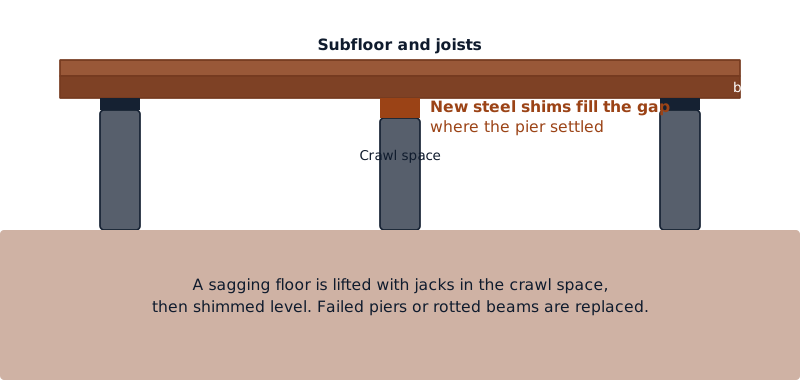
The main causes, roughly in the order they show up in older homes here:
| Cause | What it does to the floor | Typical sign |
|---|---|---|
| Shallow original supports | Brick, block or wood posts sink unevenly into soft clay | Floor drops toward one wall or corner |
| Clay that shrinks and swells | Lifts and drops the house edges with the weather | Doors stick in one season, free in another |
| Wood shrinkage and creep | Beams and joists settle into a slight sag over long spans | Gentle dip mid-room between supports |
| Rot or termite damage | Weakens a joist, sill or beam in one area | Soft, bouncy patch, often near a bathroom |
| Additions and remodels | New sections sit on different supports from the old house | Step or ridge where old meets new |
The USDA describes Lake Charles clay, a common soil in the Houston area, as 45 to 60 percent clay, with cracks up to 2 inches wide and 12 inches or more deep opening in dry weather. The supports that hold up an older house were usually set shallow, not deep into firmer ground, so they ride that movement up and down.
When the dip sits between supports rather than at one edge, the sag is usually in the wood; sagging floor joist repair covers that.
How much floor slope is normal in an old house?
There is no legal limit for an old floor, but Texas engineers use guidelines to judge foundation movement. The Foundation Performance Association's guideline sets a tilt limit of 1 percent, about 1.2 inches over 10 feet, and a bending limit of roughly the length divided by 360, about 1 inch over 30 feet. Readings inside those limits usually mean the foundation has performed within normal design limits.
Those figures are a guide for engineers, not a test you run with a level. The committee also noted that a steeply sloped floor can be a problem to live with even when the walls show little damage. Treat them as a sense of scale:
- A small, even slope across a room is common in old houses and often harmless.
- A tilt close to 1 percent, or a dip that adds up to an inch or more across a room, is worth measuring properly.
- A sharp drop over a few feet, a ridge or a step is a sign something specific failed, whatever the overall numbers say.
Only a proper elevation survey, done with a level instrument across the whole floor, gives readings an engineer or contractor can compare with these limits.
How can you tell old settling from a floor that is still moving?
You tell them apart by measuring over time. Take floor readings and photograph every crack now, then check again after a few months and after a change of season. If nothing has changed, the slope is probably old settling. New or wider cracks, doors that start sticking, or readings that drop further point to a support that is still moving and needs attention.
A simple way to keep track without special tools:
- Pick four or five fixed spots per room and measure down to each from a string or laser line set across the room. Write the numbers down.
- Mark the ends of cracks in pencil with the date, and photograph them with a coin for scale.
- Note which doors and windows stick, and in which month.
- Repeat in a dry month and a wet month.
Look outside too. A driveway or walkway pulling away from the house, or soil shrinking back from the slab edge in summer, shows the ground is still active. For more on reading cracks and the line between settling and damage, see foundation problems vs settling.
Are uneven floors in an old slab house different from a pier and beam house?
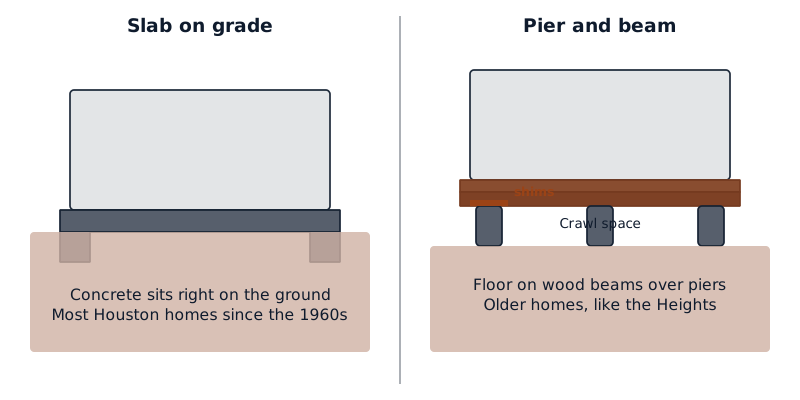
Yes. In an older pier and beam house, the floor sits on beams over a crawl space, so slope usually comes from sunken piers, crushed shims or sagging wood, and it can often be adjusted from underneath. In an older slab house, the floor is the foundation, so a sloping floor means the slab itself has moved and any fix happens at the slab edge.
The City of Houston's Heights design guidelines describe its houses as mostly wood siding on pier and beam foundations, with Craftsman bungalows popular from 1905 to 1925. Most slab homes in the area are newer. The two age differently:
| Older pier and beam house | Older slab house | |
|---|---|---|
| Usual slope pattern | Dips toward one wall, waves between supports | Edges or one corner lower than the center, or the reverse |
| Floor feel | Can be bouncy or soft in spots | Hard and solid, slope felt only by eye or marble |
| Who can adjust it | Shims and some framing from the crawl space; piers need a contractor | Only a contractor, with piers under the slab |
For how a raised house is brought back up in stages, see house leveling for pier and beam homes.
Should uneven floors stop you buying an old house?
Uneven floors alone are not a reason to walk away from an old house. Nearly every older home has some slope. What matters is whether it is still moving, what is causing it, and what the fix would cost. Get the floor measured and the crawl space or slab edge looked at before you commit, and use the findings to plan or negotiate.
Ask the seller what foundation work has been done and whether a permit was pulled. Inside the City of Houston, foundation repair needs a building permit; the city's own permit reports list residential shim and level jobs on block and base foundations. A past repair with paperwork is better news than one without.
For rough numbers, a 2026 Houston Press guide puts most Houston foundation repair jobs at $3,300 to $6,800, and This Old House puts a structural engineer's report at $500 to $1,000. More on the buying side, including what to ask for in an inspection, is in buying a house with foundation issues.
When is an old house's uneven floor worth a professional visit?
Have a professional look when your own readings change, when a drop is sharp rather than gentle, when a pier is visibly tilted or sunk, or when new cracks and sticking doors appear together. Those are signs of a support that is still failing. A gentle, stable slope you have watched for a year usually only needs a visit if you plan a remodel, new flooring or a sale.
A visit normally means an elevation survey, a look at the crawl space or slab edge, and an explanation of the readings, with a written scope and price before any work. If the floor is stable and you just want it flatter, the surface methods are in how to level a floor in an old house.
We'll arrange a visit from a local foundation contractor who measures the floor, explains what is old settling and what is new, and puts any price in writing before work begins.
Questions people ask
Do old houses keep settling forever?
Most of a house's settling happens in its early years, so an old house that has sat still for decades is often stable. On Houston clay, though, the ground keeps moving with wet and dry seasons, so an old house can still shift a little each year. Steady movement in one direction, rather than a seasonal back and forth, is the kind that usually needs attention.
Can uneven floors in an old house be dangerous?
Usually not in themselves. A gentle slope is mostly an annoyance. A floor becomes a safety issue when a joist or beam is badly rotted, when a pier has failed and the floor feels soft or springy, or when a sudden drop creates a trip hazard. Any spot that sags or gives underfoot should be checked from below before it gets heavy use.
Is it worth leveling an old house just because the floors slope?
Often not, if the slope is gentle and stable. Lifting an old house back to dead level can crack plaster and jam windows that have adjusted to the old shape. It tends to be worth it when the floor is still dropping, when doors and windows no longer work, or before new tile or hardwood that needs a flat base.
Why do old house floors seem worse in summer?
Because the clay under many Houston homes shrinks as it dries. The USDA says Lake Charles clay cracks open in dry weather and those cracks stay open 60 to 90 days in most years. As the soil pulls back, the edges of a house can drop a little, then rise again after steady rain. A floor that changes with the seasons is moving, even if it returns each winter.
For the wider picture, start with Foundation Repairs Houston Quotes.
Sources
- Foundation Performance Association, August 2007 meeting notes on FPA-SC-13 movement guidelines
- USDA NRCS, Lake Charles soil series description
- Houston Heights design guidelines, City of Houston Planning
- City of Houston weekly building permit report, July 2024
- Houston Press, guide to foundation repair in Houston (2026)
- This Old House, foundation repair cost guide (October 2026)
Last changed