Concrete slab cracks form because concrete shrinks as it dries and the ground holds it back, so tension builds until the slab splits. That much is normal, and those hairline cracks rarely weaken a slab. On Houston clay a second cause takes over later: the soil swells and shrinks, leaves parts of the slab unsupported, and bends it. The age, shape and location of a crack tell you which cause you have and which repair fits. For the full range of crack repairs on a house, start with foundation crack repair in Houston. This page stays with the slab itself.
Why do concrete slabs crack?
Concrete slabs crack because concrete loses volume as the water in it dries out, and the ground, the steel and the rest of the house stop it shrinking freely. When the pull from that restraint is greater than the concrete's tensile strength, a crack opens. A University of Wisconsin extension guide calls drying shrinkage an unavoidable, built-in property of concrete, which is why almost every slab has some cracks.
The same guide lists the other causes: heavy loads, bending over uneven support, and settlement of the ground.
Some things raise the odds from the day of the pour:
- Too much water in the mix. It increases shrinkage and lowers strength.
- Poor curing. A slab that dries too fast on top cracks more.
- Uneven ground preparation. A slab bridges soft spots and cracks over them later.
- Missing joints. Contraction joints, the straight grooves cut into garage and patio slabs, give shrinkage a planned place to crack. A crack running along one of those grooves is the joint doing its job.
Which slab cracks show up while the concrete is new?
Two kinds of crack belong to a slab's first weeks and months. Plastic shrinkage cracks form within hours of the pour, while the concrete is still soft, when the surface dries faster than water can rise to replace it. Drying shrinkage cracks appear over the following months as the hardened slab loses moisture. Both are usually fine lines, and neither on its own means the foundation is moving.
Penn State's concrete engineering material describes plastic shrinkage cracks as typically about 1/8 inch wide and 2 to 4 inches deep, sometimes in a crow's-foot pattern, and most common when it's hot, dry and windy at the pour. Houston summers make them common in new garage floors.
Drying shrinkage leaves straighter hairline cracks. If a crack appeared in the first year or two and hasn't changed since, shrinkage is the likely cause.
How does Houston clay crack a slab after it has cured?
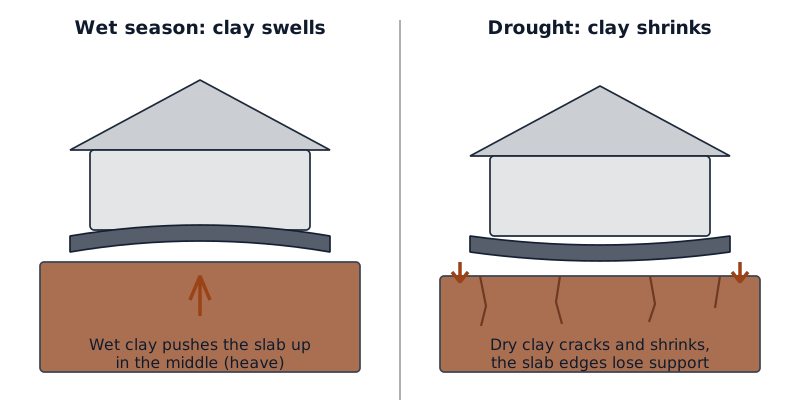
Houston clay cracks a cured slab by moving under it. Clay that swells when wet and shrinks when dry gives a slab uneven support, so one part sits higher or lower than another and the slab bends until it cracks. The USDA describes Lake Charles clay, common across the area and first mapped in Fort Bend County, as 45 to 60% clay that opens cracks 1/2 to 2 inches wide in dry spells.
Those soil cracks reach 12 inches or more down and stay open 60 to 90 days in most years, by the USDA's count. East of the Trinity River, around Baytown, Beaumont clay behaves the same way.
Moisture is the switch. A slab edge beside a downspout, or a bed that's never watered, swings more than the middle of the house, and a plumbing leak under the slab swells the clay from below. Fixing that water is often the first step in fixing the crack, and foundation drainage covers how it's done.
What does the location of a slab crack tell you?
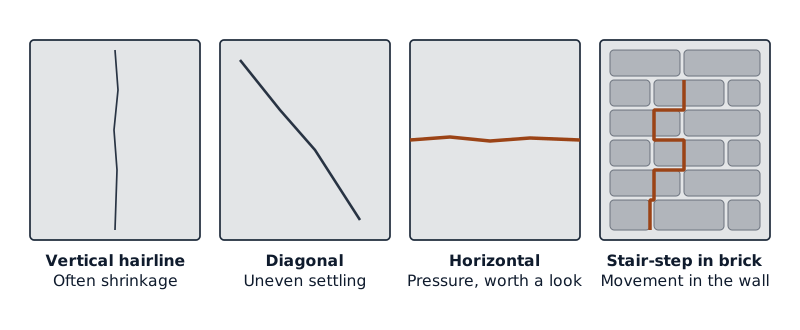
Where a crack sits narrows down its cause. A fine crack across the garage floor or along a contraction joint is usually shrinkage. A crack that shows through tile or makes a floor feel uneven, one that runs out through the slab edge, or one where one side sits higher than the other points to movement in the soil under the house.
| Where you see it | Likely cause | What usually follows |
|---|---|---|
| Garage floor, straight hairline | Drying shrinkage | Seal it to keep water out, or leave it |
| Along a cut groove in the slab | Planned contraction joint | Nothing; it's working as designed |
| Tile cracking along a straight line indoors | A slab crack under the flooring | Lift a tile and check width and offset |
| Slab edge or grade beam outside | Shrinkage or edge movement | Mark it and watch it through a season |
| One side higher than the other | Settlement or heave | A contractor visit |
| Crack plus sticking doors or sloping floors | The slab is moving | A contractor visit, possibly piers |
Horizontal cracks belong to walls under sideways pressure, such as a basement wall, and Houston homes almost never have a basement. On a slab, the questions are width, offset and growth. When foundation cracks are worth worrying about covers those thresholds.
How do you repair concrete slab cracks?
You repair a concrete slab crack by matching the filler to the crack. A dry crack that has stopped moving takes a rigid epoxy, which bonds both sides together. A crack that still opens and closes a little with the seasons needs a flexible polyurethane sealant that stretches with it. A crack caused by the soil moving needs the movement stopped first, or any filler will crack again.
| Crack | Better filler | Why |
|---|---|---|
| Stable, dry, hairline to narrow | Low-viscosity epoxy | Rigid bond across the crack |
| Opens and closes with the seasons | Polyurethane sealant | Stays flexible, keeps out moisture |
| Offset or still growing | No filler yet | The cause is under the slab |
A national 2026 cost guide puts crack filling at about $250 to $800. When the slab needs piers instead, most Houston jobs fall between about $3,300 and $6,800, according to a 2026 Houston guide. The foundation crack repair cost page breaks the numbers down, and the hands-on steps for sealing a crack are in how to repair a cracked foundation.
Why shouldn't you drill or saw into a cracked slab?
You shouldn't drill, core or saw a slab to repair a crack until you know how it was built, because many homes on expansive clay sit on post-tensioned slabs. These carry steel tendons pulled tight after the concrete hardens. Cutting one can be dangerous and is difficult to put right. A surface sealant needs no drilling at all, so that's the safe limit for a homeowner.
The Post-Tensioning Institute says its guidelines for these foundations on expansive soils date from 1980 and have been used on millions of homes, so treat a newer house as possibly post-tensioned until someone checks.
There's a legal line too. In the City of Houston, foundation repair needs a building permit; one week of city permit reports in July 2024 listed 23 of them. Cutting, lifting or piering a slab is a job for a contractor who pulls that permit. Other cities set their own rules, so check with their building department.
When does a slab crack need more than sealing?
A slab crack needs more than sealing when it keeps growing, one side has dropped or risen, it comes back after a repair, or the house shows other signs of movement such as sticking doors, gaps at window frames or a floor you can feel slope. Those are signs of the soil moving the slab, and the repair is underneath it.
A serious crack is a symptom. The usual fix is piers under the low section, lifting it toward level, then sealing what's left, with drainage or a leak repair first when water caused the movement. Concrete slab foundation repair explains each method.
For a professional opinion, we'll arrange a visit from a local foundation contractor who measures the crack, checks the floor level and puts a written slab crack quote in your hands before any work starts.
Indoors, a slab crack usually shows up through the flooring first. See foundation floor cracks for what that looks like under tile, wood and carpet.
Questions people ask
Are cracks in a new concrete slab normal?
Yes, fine cracks in a new slab are common. Concrete shrinks as it dries, and a University of Wisconsin extension guide calls that shrinkage unavoidable. Hairline cracks in the first year or two, especially in a garage, are usually cosmetic. Watch for a crack that widens, shows an offset or appears with sticking doors, which points to movement rather than drying.
Can I fill a slab crack with caulk?
You can seal a narrow, stable crack with a flexible polyurethane concrete sealant, often sold as concrete caulk. It keeps water and insects out and moves with the slab a little. It adds no strength. Clean the crack, let it dry, and press the sealant in rather than smearing it across the top.
How do I know if a slab crack is getting worse?
Mark each end of the crack in pencil with the date, measure its width at one spot, and photograph it beside a ruler. Check again every few weeks through a dry spell and a wet one. If the crack runs past the marks, gets wider or one edge rises, it's still moving and needs a contractor to look at it.
Does a sealed slab crack need waterproofing?
Usually not on a slab at grade. Waterproofing matters most on walls below ground, which Houston homes rarely have. Sealing the crack stops most moisture coming up through it. If you see damp patches, staining or water near the crack after rain, the issue is drainage or a leak, and sealing alone won't fix it.
Can a cracked garage slab be fixed without fixing the house?
Often, yes. A garage floor can crack from drying shrinkage alone while the rest of the foundation is fine. Sealing those cracks is a normal maintenance job. If the garage crack lines up with cracks in the house slab or brick, or the garage floor has sunk at one side, the movement may involve the whole foundation, and a contractor should check both.
For the wider picture, start with the foundation repair guide for Houston.
Sources
- University of Wisconsin Cooperative Extension, Concrete materials and properties (Kammel), hosted by Wisconsin DATCP
- Penn State College of Engineering, plastic shrinkage cracking
- USDA NRCS, Lake Charles soil series description
- USDA NRCS, Beaumont soil series description
- Post-Tensioning Institute, Technical Note 21 (2017)
- This Old House, foundation repair cost guide (October 2026)
- Houston Press, guide to foundation repair in Houston (2026)
- City of Houston weekly building permit report, July 2024
Last changed