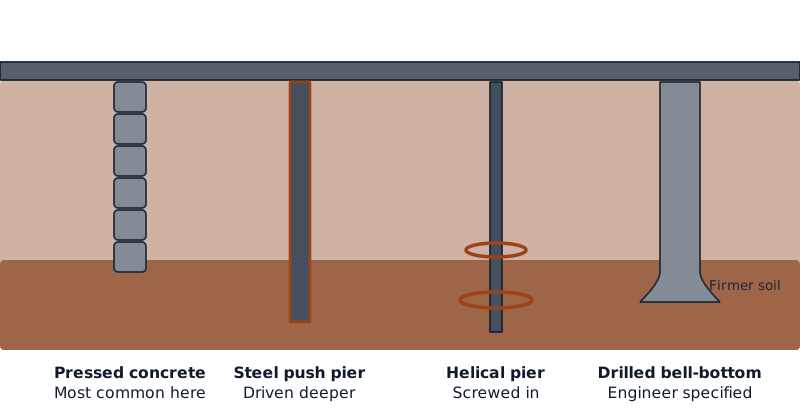
Push piers and helical piers are both steel repair piers, and the difference is how they get into the ground. A push pier is a string of steel pipe pressed straight down with a hydraulic ram, usually using the weight of the house as the counterforce. A helical pier has screw plates welded to its shaft and is turned in like a giant screw, so it doesn't need that weight. Heavy slab houses usually suit push piers. Light structures, porches and new footings usually suit helical piers. Below: how each works, the cost, and how they compare with concrete, as part of the wider guide to foundation piers in Houston.
What's the difference between helical and push piers?
The main difference is the force that drives them. Push piers are pressed down in sections against the weight of the house until the soil stops them. Helical piers are screwed in by a hydraulic motor, and the torque it takes to turn them is read to estimate how much load they will carry. That makes push piers a fit for heavy loads and helical piers a fit for light ones.
| Push piers | Helical piers | |
|---|---|---|
| How they go in | Steel pipe pressed down in sections by a hydraulic ram | Steel shaft with screw plates turned in by a hydraulic motor |
| What drives them | Usually the weight of the house above | Torque from the motor, not the house |
| How capacity is checked | The pressure at which the pier stops moving | Installation torque, plus load tests where required |
| Best for | Heavy slab houses, brick veneer walls | Porches, additions, garage slabs, new construction |
| Takes uplift (tension) | Not usually | Yes, if designed for it |
The International Building Code accepts "well-documented correlations with installation torque" as one way to set a helical pile's capacity, and it covers helical piles in tension as well as compression. Both kinds are a form of underpinning: they carry the house down past the soft surface layer to firmer ground.
Which one works better in Houston's clay soil?
For most single-story and two-story slab houses in Houston, push piers are the common choice, because the house is heavy enough to drive them deep. Helical piers win where the load is too light to push against, or where a pier must also resist uplift. In very stiff clay or dense layers, screw plates can stop short, so the soil decides as much as the house.
Houston's ground is the reason the depth matters. The USDA describes the Lake Charles clay found across the area as 45 to 60% clay that cracks half an inch to two inches wide in dry spells, a foot or more deep. A pier that stops inside that layer moves with it. Steel piers of either type aim to get well below it.
Subsidence adds to the movement. The USGS measured more than 10 feet of sinking near Pasadena between 1906 and 1995, so in the older east side neighborhoods, a pier log showing where each pier stopped is worth asking for.
How do push piers go in under a slab?
A crew digs beside the edge beam, fixes a steel bracket to the underside of the slab, and sets a hydraulic ram on it. The ram presses short sections of steel pipe down one after another, using the house as the weight, until the soil resists. Then the house is lifted toward level and the piers are locked off. Holes are backfilled.
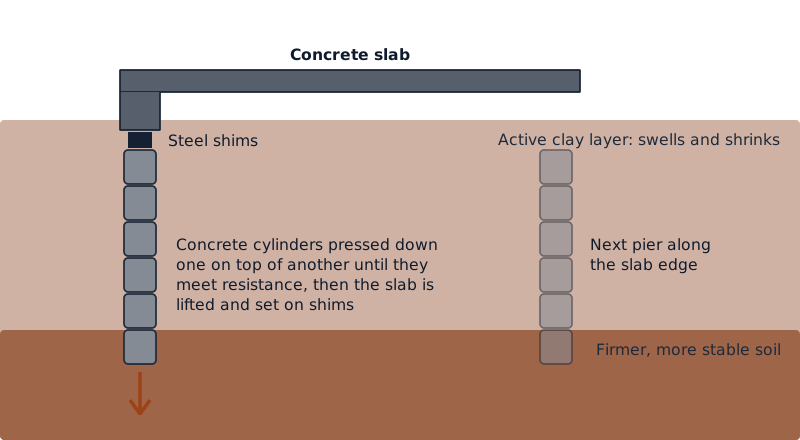
Because the house is the counterweight, a light corner can lift before the pier reaches firm soil, so a contractor watches for that and switches method if needed. Interior piers mean breaking out the slab indoors, which the Houston Press guide says adds about 15% to the cost.
The full process for slab houses is on slab foundation repair in Houston.
When are helical piers the better pick?
Helical piers are the better pick when the structure is too light to drive a push pier against, when a pier must hold down as well as up, or when you're building something new. Porches, garage slabs, room additions and decks are frequently set on helical piers, and because they're all steel there's no concrete to cure before work moves on.
They also suit older houses that need a new support under a beam with little weight above it; pier and beam foundation repair explains how that work runs. Plate size and count come from a design for your load and soil. Our page on helical pier foundation repair goes into the method in more depth.
Helical piers vs push piers cost: which costs more in Houston?
Both are steel piers, and steel costs more than pressed concrete. The 2026 Houston Press guide puts steel piers at $1,000 or more each, against $300 to $600 for pressed concrete. This Old House puts piering at $1,000 to $3,000 per pier nationally. Which steel type costs more on your job depends on depth, load and access more than the label.
| Item | Typical range | Source |
|---|---|---|
| Steel pier (push or helical), each | $1,000 and up | Houston guide, 2026 |
| Piering or underpinning, each pier | $1,000 to $3,000 | National guide, 2026 |
| Pressed concrete pier, each | $300 to $600 | Houston guide, 2026 |
| Typical Houston repair job, total | $3,300 to $6,800 | Houston guide, 2026 |
| Structural engineer report | $500 to $1,000 | National guide, 2026 |
Tight side yards, decks and landscaping add 6 to 8% to pier costs, the Houston guide says. These are guides, not quotes. Inside the City of Houston, foundation repair runs under a building permit, and the city's weekly reports list them. More detail is on pier foundation cost and foundation repair cost in Houston.
Are steel piers better than concrete piers?
Steel piers go deeper and carry more per pier, so they suit heavy houses and deep firm soil. Pressed concrete piers cost much less and are the most common repair here, but they stop at shallower depths. Neither is better in every case. The right choice depends on how far down firm ground sits under your house and what you can spend.
A concrete footing is a different thing again: a shallow pad poured in a hole. On Houston's shrink-swell clay, a footing near the surface tends to move with the ground. The detailed comparison is on helical piers vs concrete footings.
What's the difference between pile and pier foundation?
In strict engineering terms, piles are driven or screwed into the ground and piers are drilled and filled with concrete. Both are deep foundations that carry a building's weight down to firmer soil. In everyday Houston repair work the words blur: push piers and helical piers are technically piles, yet nearly everyone calls them piers. So "helical piles" and "helical piers" on two quotes mean the same thing.
Is a slab or pier foundation better?
Neither is better everywhere. A slab on grade is cheaper to build and is what most Houston homes since the 1960s sit on. A Pier Foundation, with beams over a crawl space, lifts the floor off wet ground and gives access to plumbing, but needs more upkeep. On Houston clay both can move, and both can be repaired with piers.
For a repair, what matters is which pier suits the foundation you have. A local foundation contractor can tell you after looking under the house. When you're ready, ask for a written pier quote and we'll arrange a visit.
Questions people ask
How long does a helical or push pier job take?
It depends on the pier count, how deep each pier has to go, and whether any go indoors. Helical piers have no concrete to cure. Ask the contractor for a timeline in the written quote, plus the time to backfill and clean up the dig holes around the house.
What should I ask before I hire someone for helical or push piers?
Ask which pier type they propose and why, how many piers, where each goes, and the target depth or torque. Ask whether a structural engineer has reviewed the plan, who pulls the permit, and whether you get a pier log at the end. Ask what written terms come with the work, and get every quote itemized so you can compare them.
Do I need to be home while piers are installed?
You usually don't need to be home for exterior piers, but someone should be there at the start and at the end to walk the job. Interior piers mean breaking the slab inside, so you'll need to clear furniture and be around to give access. Plumbing may need checking after the lift.
Can I buy hydraulic push piers and install them myself?
Push pier kits and hydraulic rams are for sale through suppliers, mostly aimed at contractors. Lifting a house is not a DIY job: it needs a plan for every pier, the right equipment, and in the City of Houston a building permit. A bad lift can crack the slab or the drain lines below it. For a house, get a contractor's written quote.
Do helical piers work under a pier and beam house?
Yes. Helical piers suit pier-and-beam houses well, because the load on each beam is fairly light and push piers need weight to drive against. They're frequently used to replace failed wood or block piers and to support new beams. The design should set the plate size and depth for your soil.
Every service and price guide is on foundation repair across Houston.
Sources
- International Building Code 2021, Texas edition, Chapter 18 (Section 1810, helical piles)
- Houston Press, guide to foundation repair in Houston (2026)
- This Old House, foundation repair cost guide (October 2026)
- USDA NRCS, Lake Charles soil series description
- USGS Fact Sheet 110-02, land subsidence in the Houston-Galveston region
- City of Houston weekly building permit report, July 2024
Last changed