Yes, you can install your own foundation piers, as long as they hold up something small and new: a deck, a shed, a porch landing or a carport post. Small helical piers and poured concrete piers are both within reach of a careful homeowner with the right tools. What you can't do yourself is pier an existing house to stop it sinking or to lift it back to level. That is underpinning, and in the City of Houston it runs under a building permit. This guide walks through both DIY methods step by step, then draws the line. For how repair piers work under a house, start with foundation piers in Houston.
Can I install helical piles myself?
You can install small helical piles yourself for a deck, shed or light outbuilding. You screw each one into the ground with a rented hydraulic drive head or, for the smallest sizes, a hand bar, and stop when the resistance tells you it has reached firm soil. Repair-grade helical piers under a house are a different job, because they carry a wall and need a design, a torque record and a staged lift.
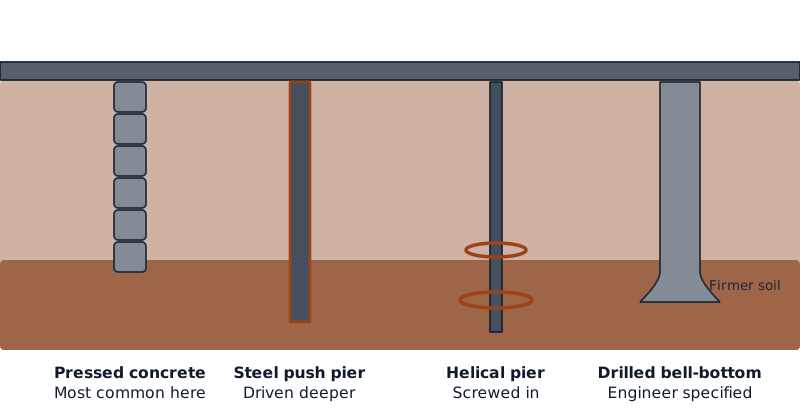
The difference is load and evidence. A deck post carries a modest load and, if it settles, you can shim it. A pier under a slab beam carries part of the house, and nobody can see whether the helix bearing below it is sound. Contractors judge that from installation torque. Research at Colorado State University, drawing on 799 full-scale load tests, found the link between torque and capacity also varies with the helix setup, the direction of load and the soil type, not only the shaft. That is why a house pier comes with an engineer's target torque and a written log, and a deck pier usually doesn't need one.
How do you install helical piers under a deck or shed?
You lay out the post positions, locate buried utilities, then drive each helical pier plumb into the ground with steady pressure until it reaches the torque or depth in the product's instructions. You cut the shaft to height, fit the bracket, and build on top.
- Mark the layout. Set string lines and mark every post or beam support. Check the diagonals so the frame is square.
- Have utilities located. Under Texas law, anyone digging with powered equipment must notify the state's notification center at least 48 hours ahead, not counting weekends and holidays. Call 811 to reach it.
- Check the permit. Decks and larger sheds often need one. Ask your city's building department before you buy materials.
- Start the pier plumb. Hold a level on two faces of the shaft for the first few turns.
- Drive at a steady pace. Keep down-pressure on so the helix screws in rather than augering the soil loose.
- Read the resistance. Stop at the depth or torque the manufacturer's installation guide gives for that pier size. If one pier spins freely far deeper than the others, note it: the soil there is softer.
- Cut, cap and level. Trim each shaft to height, fit the bracket, and set the beam.
In Houston clay, the top foot or so is the part that misbehaves. The USDA's description of Lake Charles clay, a soil series with its type location in Fort Bend County, records surface cracks half an inch to two inches wide reaching 12 inches or more deep when dry. A helix sitting below that layer is the whole point of using a pier.
How do you build concrete foundation piers for a small structure?
You dig or auger a hole below undisturbed soil, set a cardboard form tube, add a bracket or anchor, fill it with concrete in one pour and let it cure before loading. The residential code most cities adopt puts exterior footings at least 12 inches below undisturbed ground. On Houston clay, deeper and wider at the base holds better than the minimum.
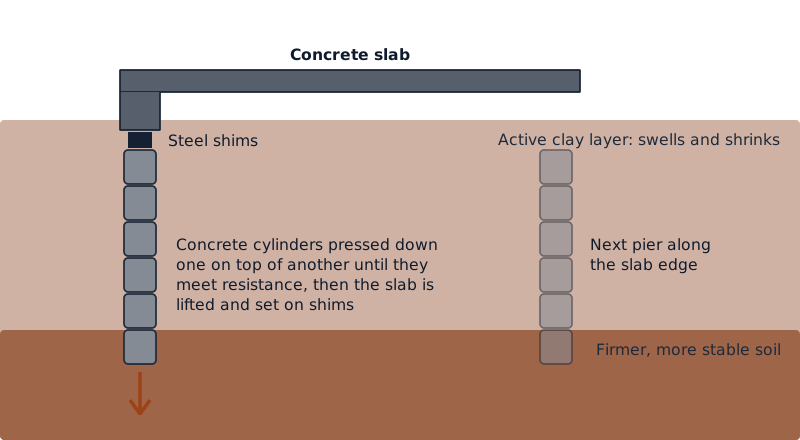
That depth figure matters here. A 12-inch footing sits inside the band where Lake Charles clay opens and closes with the seasons, so it can move up and down with every wet and dry spell. That is why poured piers for decks in this area are often taken deeper and given a wider bell or footing at the bottom. Concrete pier construction in more detail, including forms, mixes and spacing, is on do it yourself concrete pier foundation. How contractors press precast concrete cylinders under a house is a separate method, set out on concrete foundation piers.
Which DIY pier suits a deck, shed or porch?
Helical piers suit wet or tight sites because they go in with no digging, no spoil and no curing time, and you can build the same day. Poured concrete piers cost less in materials and suit dry, open ground. Precast pier blocks that sit on the surface are fine only for small, low structures that can tolerate some movement.
| Pier type | Good for | Strengths | Watch out for |
|---|---|---|---|
| Small helical pier | Decks, sheds, porches, ramps | No digging, load right away, works in wet ground | Needs a drive head; stop where the instructions say |
| Poured concrete pier | Decks, pergolas, carport posts | Cheap materials, simple tools | Utility locate, curing time, seasonal clay movement |
| Precast surface block | Small sheds, landscape steps | Fastest, no digging | Sits in the active clay layer, so expect to reshim |
Why can't you pier your own house?
You can't safely pier your own house because the piers have to be placed by load, driven to proven resistance, and then used to lift the structure evenly while it is still standing on them. One pier lifted too far cracks the slab, the brick or the drain lines under it. In Houston that work is foundation repair and needs a building permit.
Underpinning turns the job upside down. With a deck, you set piers first and build on them. With a house, the weight is already there, so piers go in against it beside the beam, and the house is raised a little at a time with a jack on each pier. The City of Houston's weekly permit reports list residential foundation repair permits, including "shim and level" jobs. Which pier type goes under a house is covered in helical vs push piers.
How do you level a house on piers?
You level a pier and beam house by jacking each low beam gently from solid support, setting permanent shims or new piers at the new height, and checking floor heights throughout so nothing rises faster than the rest. It is staged work, often over more than one visit, and inside the City of Houston it runs under a permit.
What you can do yourself is the groundwork: map the floor with a long level or laser, note which rooms are low, fix plumbing leaks and drainage under the house, and clear access to the crawl space. The contractor's process, step by step, is on house leveling for pier and beam homes.
Do you need a permit or a utility locate before you dig?
You need a utility locate before any powered digging, and you may need a permit too. Texas law defines excavation to include disturbing soil 16 inches or deeper with powered equipment, which covers a gas auger or a helical drive head. Permits depend on the city and the structure, so check with your building department before you start.
For a deck or shed, each city sets its own limits, and some small sheds can be exempt. For any pier under a house, a permit is needed inside the City of Houston, and suburbs such as Bellaire run their own rules. If you're unsure whether your job is small enough to do yourself, a broader look at what a homeowner can take on is in DIY foundation repair.
If your question is about piers under the house itself, we'll arrange a visit from a local foundation contractor, and you get a written price before any work starts. Ask for a pier quote.
Questions people ask
How deep should DIY piers go in Houston clay?
At least below the active clay layer. The code minimum for exterior footings is 12 inches below undisturbed ground, but Houston's Lake Charles clay can crack 12 inches or more deep when dry, so a footing at the minimum still sits in moving soil. For helical piers, follow the depth or torque in the installation guide. For a large deck or anything attached to the house, ask the building department what they expect.
How long does it take to install DIY foundation piers?
Helical piers for a small deck can often go in over a day or a weekend, because there is no digging and no curing, and you can build on them straight away. Poured concrete piers take longer: a day to dig and pour, then curing time before you load them, as the mix's instructions set out, plus the 48-hour notice for a utility locate before any powered digging.
What tools do you need to install helical piers?
For small helical piers you need a hydraulic drive head or a heavy hand bar, a level for keeping the shaft plumb, a measuring tape and string lines, a saw that cuts steel, and the brackets for your posts. Drive heads are usually rented. Repair-grade piers for a house need much bigger equipment and a torque reading, which is part of why they are a contractor's job.
Are DIY piers cheaper than hiring a contractor?
For a deck or shed, usually yes, because you're paying for materials and a tool rental. For a house, the comparison doesn't hold. Houston pricing guides put concrete repair piers at about $300 to $600 each and steel piers at $1,000 or more, and national figures run $1,000 to $3,000 per pier. That price covers the design, the lift and the permit, not only the pier.
This guide is one of many on Foundation Repairs Houston Quotes foundation repair.
Sources
- USDA NRCS, Lake Charles soil series description
- Texas Utilities Code, Chapter 251 (underground facility damage prevention)
- City of Grand Rapids building guide quoting International Residential Code R403.1.4
- Souissi, Helical pile capacity to torque ratio, Colorado State University (2019)
- City of Houston weekly building permit report, July 2024
- Houston Press, guide to foundation repair in Houston (2026)
- This Old House, foundation repair cost guide (October 2026)
Last changed