Helical pier foundation repair means screwing steel shafts with spiral plates into the ground beside a sinking foundation, turning them down until the torque shows they've reached soil that can hold the load, then bracketing them to the house and lifting it back toward level. It suits lighter loads, pier-and-beam homes, porches and additions, and spots where a push pier can't get enough weight to drive against. This page walks through the job itself: the steps, how the pier count is set, what the building code asks for, buying piers, and the concrete options. For the full range of pier types, start with foundation piers in Houston.
How does helical pier foundation repair work?
A crew digs a small hole at each pier spot, sets the helical pier against the foundation and screws it down with a hydraulic torque motor, adding extension sections as it goes. They read the torque until it reaches the target the design sets. Then a steel bracket ties the pier to the beam or slab edge, the house is lifted, the brackets are locked, and the holes are backfilled.
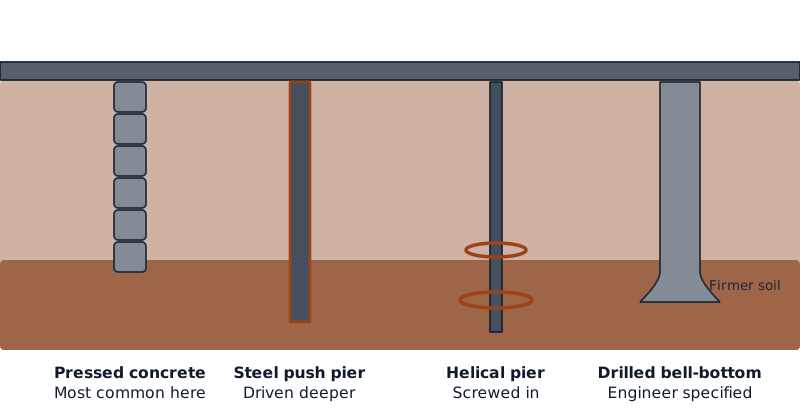
A typical job on a Houston house:
- Assessment. A contractor or structural engineer measures how far the floor has dropped, marks where each pier goes and sets the target torque and depth.
- Permit. Inside the City of Houston, foundation repair runs under a building permit; the city's weekly permit reports list foundation repair permits every week.
- Excavation. A hole is dug beside the grade beam at each mark, or under the beam from the crawl space on a pier-and-beam house.
- Installation. The lead section, which carries the plates, is screwed in first. Extensions are bolted on until the pier reaches the design torque.
- Bracketing and lift. A bracket joins each pier head to the foundation. Hydraulic jacks lift the house a little at a time, all piers together.
- Lock off and backfill. Brackets are fixed at the final height, the jacks come off, and the soil goes back.
- Records. You get a log showing each pier's depth and final torque.
When is a helical pier the right repair for a Houston house?
A helical pier is the right repair when the part of the house that's sinking is too light to push a steel pier against, or when the pier also needs to resist uplift. That makes it a frequent choice for pier-and-beam homes, porches, garages, room additions and one-story wings. Heavy slab houses with brick veneer usually take push piers or pressed concrete piers instead.
The ground matters as much as the house. Much of Houston sits on expansive clay such as the Lake Charles series, which the USDA describes as 45 to 60% clay that cracks open when dry, with cracks reaching 12 inches or more deep. A helical plate must sit below that moving layer or it rides up and down with it, and stiff clay or buried debris can stop plates short. The side by side comparison with push piers is on helical vs push piers, and work under older raised houses is covered on pier and beam foundation repair.
How many helical piers do I need?
The number of helical piers depends on how much of the foundation has moved, how heavy that section is, and what each pier can carry in your soil. A sunken porch might need only a few. A whole side of a house can need many more. Spacing comes from dividing the wall's load by each pier's design capacity, so a sound count comes from a design, not a rule of thumb.
What changes the count:
| Factor | Effect on the number of piers |
|---|---|
| Length of foundation that has dropped | More length, more piers |
| Wall load (one story, two story, brick or siding) | Heavier walls need piers closer together |
| Pier capacity in your soil | Higher capacity per pier allows wider spacing |
| Interior settlement | Adds piers under interior beams or through the slab |
| Corners and load points | Usually get a pier of their own |
Ask each contractor to mark every pier on a plan. Very different counts often mean one quote covers the whole failing section and the other only the worst corner. A structural engineer foundation inspection settles it.
What are steel helical piers, and how is their capacity checked?
Steel helical piers, also called helical piles or screw piles, are steel shafts with one or more round bearing plates welded on like a screw thread. The shaft carries the load down; the plates bear on firm soil. The International Building Code, which Texas uses, requires that shaft size and the number, size and thickness of plates be enough to support the design loads.
The code gives several ways to set a helical pile's capacity and takes the lowest. Among them: the plates' bearing area against the soil, correlations with installation torque, load tests where required, and the strength of the shaft, its couplings and the plates themselves. Section 1810.4.11 says helical piles are installed to the embedment depth and torque set by a registered design professional, and the torque used must not exceed the manufacturer's rated maximum. Section 1810.4.12 calls for special inspection of helical piles. So ask to see the torque and depth for every pier.
Where can you buy helical piers?
You can buy helical piers from foundation and construction supply distributors, and smaller ones for decks and sheds are sold through home improvement stores and online. Repair-grade piers for lifting a house usually come through distributors who supply contractors, along with the brackets and torque equipment. Buying them is easy; installing them under a house is where homeowners get stuck.
A house pier needs a hydraulic torque motor, a torque reading and a design that sets the target, then an even lift with jacks at every pier. Done badly, the slab or drain lines can crack. A small helical pier under a deck post or shed is a fair DIY job; a house needs a permit and a contractor. See DIY foundation piers.
Are concrete block or precast concrete piers an alternative?
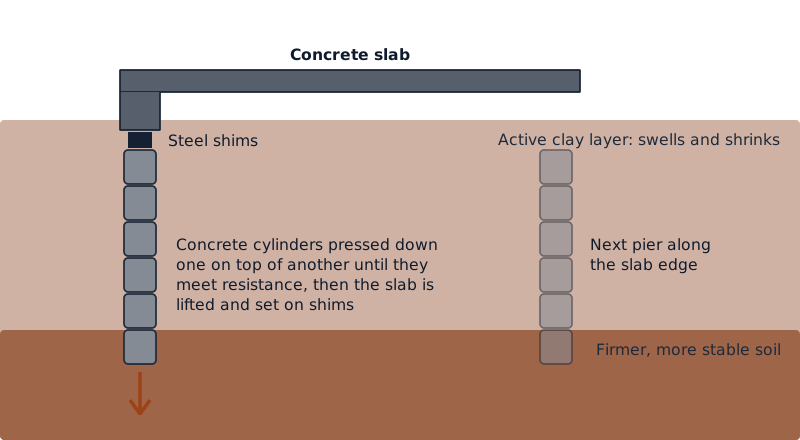
Yes, in some cases. Precast concrete piers, pressed down in stacked cylinders, are the most common slab repair in Houston and cost less per pier than steel. Concrete block piers, stacked on a footing, are the traditional support under pier-and-beam houses. Both work, but they stop shallower than steel piers, so they're more exposed to the clay's swelling and shrinking.
The options side by side:
| Pier | Where you'll see it | Main limit |
|---|---|---|
| Steel helical pier | Pier-and-beam homes, porches, additions, new construction | Higher cost per pier |
| Pressed precast concrete pier | Most Houston slab repairs | Depth limited by how far the house's weight can press it |
| Concrete block pier on a footing | Crawl spaces of older raised houses | Sits near the surface, can shift with the soil |
| Precast concrete pier block | Sheds, decks, small outbuildings | Not built to carry a house |
A precast pier block for a shed sits on the ground and spreads a light load. The code sets an 8 inch minimum width for precast concrete deep foundation elements, so house piers are a different product. More on pressed piers is on concrete foundation piers.
What are the disadvantages of pile foundation?
Pile foundations, helical piles included, cost more per support than shallow footings, need specialist equipment and a design, and their final depth isn't known until each one is installed. In repair work they also only steady the part of the house they sit under. If the rest of the foundation keeps moving, new cracks can open beside a repaired section.
Helical piers add a few of their own. Each costs more than a pressed concrete pier: the Houston Press guide puts steel piers at $1,000 or more each against $300 to $600 for concrete, and This Old House puts piering at $1,000 to $3,000 per pier nationally. Plates can stop short in dense layers. And the steel needs a protective coating to slow corrosion in wet ground. These figures are a guide; the written quote sets the real price, and the full picture is on pier foundation cost.
For a helical pier quote, ask for a written quote and we'll arrange a visit from a local foundation contractor.
Questions people ask
How long does helical pier foundation repair take?
It depends on how many piers go in, how deep each one has to be screwed before it reaches the design torque, and whether any piers are indoors. Helical piers need no concrete curing time, so the lift can follow straight after installation. Ask for the expected number of days in the written quote, including backfill and cleanup.
What should I ask before I hire someone for helical pier foundation repair?
Ask how many piers, where each goes, and the target torque and depth. Ask who designed the layout, who pulls the City of Houston building permit, and whether special inspection is included. Ask for a pier log at the end, and what written terms come with the work. Compare quotes pier for pier, not just on the total.
Do I need to be home for helical pier foundation repair?
Not for the whole job. Exterior piers can go in while you're out, though someone should be there at the start to agree pier positions and at the end to walk the work and get the pier log. Interior piers or crawl space work need access inside, so plan to be home on those days.
Can helical piers be used for new construction?
Yes. Helical piers are frequently used to build new porches, decks, room additions and light structures, because they carry load as soon as they're installed and need no concrete to cure. For a new build, the size and depth come from the design, and a building permit applies just as it does for repair.
This guide is one of many on Houston foundation repair.
Sources
- International Building Code 2021, Texas edition, Chapter 18 (Sections 1810.3.1.5, 1810.3.3.1.9, 1810.3.5, 1810.4.11, 1810.4.12)
- Houston Press, guide to foundation repair in Houston (2026)
- This Old House, foundation repair cost guide (October 2026)
- USDA NRCS, Lake Charles soil series description
- City of Houston weekly building permit report, July 2024
Last changed