Leveling house jacks are the lifting tools that raise a sunken part of a house so it can be set on new or reset supports. Screw jacks and bottle jacks handle small lifts under a raised floor. Leveling a slab takes hydraulic jacks working on piers driven deep into the ground, which is contractor work under a City of Houston building permit. A jack only lifts: it never holds a house up for good. This page covers the jack types, how each is used, the safety rules, and the floor fixes that come after. For the full repair picture, start with house leveling in Houston.
What kinds of jacks are used to level a house?
Four kinds of jack do most house leveling work: the screw jack (often sold as a house jack), the hydraulic bottle jack, the adjustable steel support post, and the multi-cylinder hydraulic systems contractors use for bigger lifts. Screw jacks and bottle jacks suit short lifts under a single beam. Adjustable posts hold a load, they don't lift it. Multi-cylinder systems lift a whole side evenly.
| Jack type | What it does well | Its limit |
|---|---|---|
| Screw jack (house jack) | Slow, controlled lifts under a beam; locks where you stop | Short travel; hard work to turn under heavy load |
| Hydraulic bottle jack | Fast lift in a tight crawl space | Can creep down; must be cribbed at once |
| Adjustable steel post | Holds a beam at a set height while blocks are reset | Built to support, not to raise a house |
| Contractor hydraulic system | Lifts several points together from new piers | Needs trained crews, piers and readings |
Every jack has a rated capacity. The federal OSHA standard for jacks, 29 CFR 1926.305, says that capacity must be marked on the jack and never exceeded. The detail on screw types is on house leveling screw jacks.
How do foundation leveling jacks work on a slab?
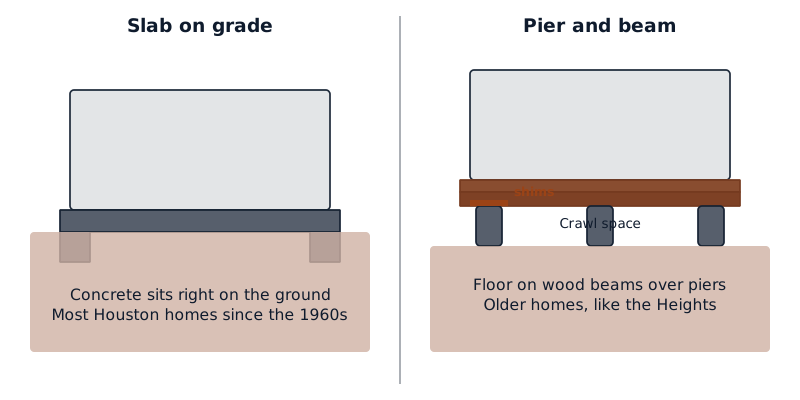
On a slab, the jacks push down on a pier to push up on the house. A local foundation contractor digs beside or under the edge beam, presses concrete or steel pier sections deep into the soil with a hydraulic ram, using the weight of the house as resistance, then sets jacks on top of the finished pier to lift the beam back toward level before shimming and locking it off.
That is why a slab can't be leveled with jacks from a hardware store. There is no crawl space to stand a jack in, and the ground right under the slab is the same shifting soil that let it sink. The USDA describes the Lake Charles clay found across much of the Houston area as 45 to 60% clay, cracking up to 2 inches wide at the surface when it dries. A jack set on that ground sinks into it.
Pier cost drives the bill. The 2026 Houston Press guide puts pressed concrete piers at about $300 to $600 each and steel at $1,000 or more, with interior piers adding about 15% to the price. The methods compared side by side are on foundation piers.
How do you level a house with jacks on pier and beam?
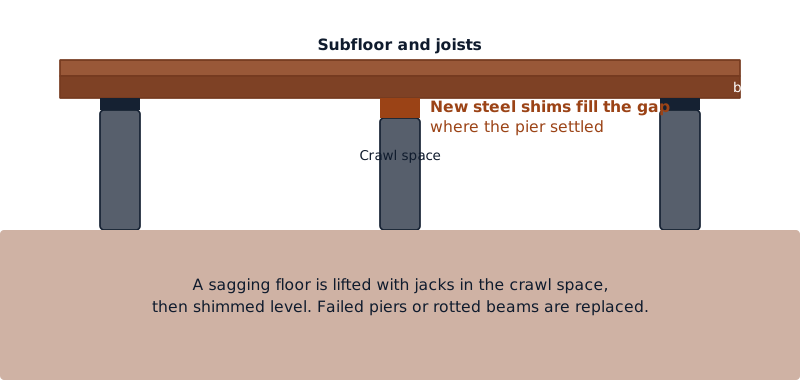
On a pier-and-beam home, you level by lifting the sagging beam a little at a time from a firm base in the crawl space, then closing the gap above the pier with shims or a reset block. You can do a short lift under one beam yourself when the piers are sound and the crawl space is safe to work in. Anything larger is contractor work.
The order a careful lift follows:
- Find the low point. Take readings with a water level or a laser level across the room above, and mark the beam and pier under the lowest spot.
- Build a firm base. Set the jack on a solid pad of cribbing or a wide footing block, not bare clay. OSHA requires the base to be blocked or cribbed when a firm foundation is needed.
- Protect the beam. Put a hardwood block between the jack cap and the beam so the metal can't slip or crush the wood.
- Lift slowly. A small turn of the screw, then stop and check the floor, doors and walls above. On an old house, a lift is often spread over days or weeks.
- Crib as you go. Stack cribbing under the beam beside the jack as it rises. OSHA says a raised load must be cribbed or blocked at once.
- Shim and set. Fill the gap above the pier with steel or hardwood shims, then lower the jack until the beam rests on the pier.
Stop and call a professional if drywall or tile starts cracking, a pier leans or is broken, the beam is rotten, or more than one line of piers needs work. Inside the City of Houston, foundation repair needs a building permit; the city's permit reports list residential shim and level jobs. The shim materials are compared on steel foundation shims.
How long does it take to level a house with jacks?
A single sagging beam on pier and beam can be lifted and shimmed in a day, though an old house may be raised in stages over several weeks so plaster and trim can adjust. A slab job with pressed piers usually takes a few days on site. The hub page covers the full timeline and what slows a job down.
Most of the time on a slab goes into digging and pressing piers, not the jacking itself. Hard, dry clay in late summer is slower to dig than soft ground, and interior piers take longer because the floor has to be cut and patched.
What tools level a concrete floor once the foundation is stable?
Once readings show the slab has stopped moving, a dip in a concrete floor is a surface job. The tools are a long straightedge or laser level to find high and low spots, a concrete grinder for ridges, a primer, a self-leveling underlayment mixed and poured over the low areas, and a gauge rake or smoother to spread it.
Self-leveling underlayment is a polymer-modified cement that flows out flat before new flooring goes down. Check the product's maximum pour depth on the bag; deeper hollows usually need a patching compound first. Don't use it to hide a slab that is still sinking: it cracks along with the slab. Step-by-step options for slab and raised floors are on how to fix uneven floors.
A sunken driveway, patio or walk is a different case. Those thin slabs are usually raised by pumping slurry or foam under them, which is covered on mudjacking.
How do you hide a small step left in an uneven floor?
Use a reducer transition strip where a higher floor meets a lower one, a beveled or adjustable threshold at a doorway, and a flexible transition piece where the floor slopes along the joint. These cover a stable step of a fraction of an inch. They do not fix a floor that is still moving, and a growing gap is a reason for an inspection.
A few points that help:
- Measure the height difference at both ends of the doorway first. On a sloping floor it often differs, and a tapered or flexible strip fits better than a straight one.
- A door that rubs at the top or won't latch after leveling may need its strike plate moved or the door planed. Give the house a few weeks to settle before trimming doors.
What does house moving and leveling involve?
House moving and leveling means lifting a whole building off its foundation on a network of hydraulic jacks and steel beams, supported on stacks of cribbing, so it can be moved to a new site or set on a new foundation. It is a specialist trade.
In Houston it mostly applies to older raised houses: a bungalow moved to a new lot, or one raised to sit higher above flood level. It needs engineered plans and permits. For a home that needs to be raised and set on new piers in place, the cost of severe-settlement lifting gives a sense of scale: This Old House puts lifting and leveling for severe settling at $20,000 to $23,000 nationally. Typical Houston leveling figures are on foundation leveling cost.
If you're unsure whether your house needs a beam shimmed or a full lift, we'll arrange a visit with a local foundation contractor, who takes elevation readings and gives you a written quote before any work starts.
Questions people ask
Can I use a car jack to level my house?
No. A car jack is built for a short lift of a vehicle for a few minutes, not to carry part of a house. It can tip or slip on a crawl space floor. Use a screw jack or bottle jack rated well above the load, set on cribbing, and crib the beam as soon as it rises. A slab house needs a contractor's hydraulic equipment and piers.
How much does it cost to level floors in a house?
It depends on whether the foundation has moved. A stable dip in a slab floor is a flooring job priced by the area. When the foundation has sunk, Houston leveling jobs typically run about $3,300 to $6,800, with concrete piers at about $300 to $600 each, according to the 2026 Houston Press guide. The quote after an inspection sets the real price.
How high can you lift a house with jacks at once?
There is no safe single figure for every house. Contractors lift in small stages and check the walls, doors and pipes between each one, because a fast lift cracks finishes that have adjusted to the old shape. On an old pier-and-beam home, a large correction may be spread over several visits. Never lift beyond what the cribbing beside the jack supports.
Do I need a permit to level my house with jacks?
Inside the City of Houston, foundation repair runs under a building permit, and the city's weekly permit reports include residential shim and level work on block and base foundations. Suburbs set their own rules, so ask your city's building department before you start. Bellaire, for one, charges a floodplain development permit fee for residential foundation work.
Should leveling jacks stay under the house?
Not as the permanent support. A jack is a lifting tool; once the beam is at height, the load should sit on a sound pier with shims or a reset block. Adjustable steel posts are sometimes left in place under a beam, but that is a support decision for a contractor or engineer, set on a proper footing, not a bottle jack left on the dirt.
For the wider picture, start with Houston foundation repair.
Sources
Last changed