To level an uneven concrete floor, first prove the slab has stopped moving, then grind down the high spots and fill the low ones with a cement-based self-leveling compound poured over a primed, clean surface. That fixes a floor that was poured rough or has small, stable dips. It does not fix a slab that is still sinking or heaving on Houston clay: that needs foundation leveling on piers first, and the surface work comes after. This guide covers how to measure the floor, the pour itself step by step, when grinding beats filling, what to do with a sunken garage or driveway slab, and where the job stops being DIY.
Is your concrete floor uneven on the surface, or has the slab moved?
A concrete floor is uneven on the surface when the dips and ridges are local, the readings stay the same for months, and doors and walls nearby are square. The slab itself has moved when the slope runs one way across a room or the house, cracks keep growing, and doors start to bind. Surface problems you can level yourself. A moving slab needs a contractor.
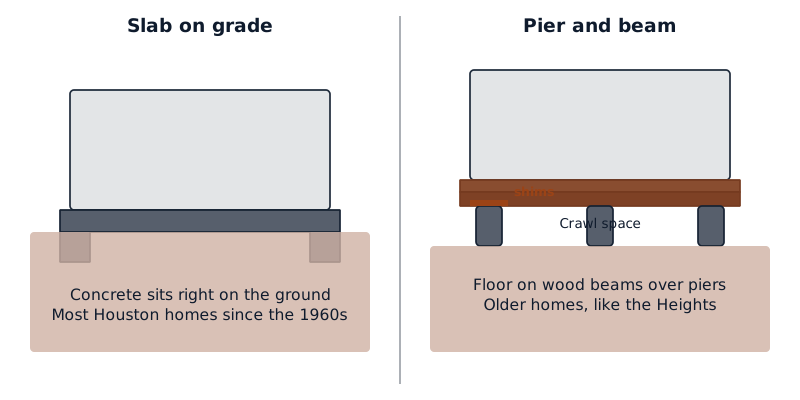
The difference matters more in Houston than in most cities. The Lake Charles clay under much of the area is 45 to 60% clay, the USDA says, and in a dry spell it cracks open half an inch to two inches wide and a foot or more deep. A self-leveling pour on a slab that is still moving will crack along with it.
The wider checks for any floor type are in how to fix uneven floors. For a slab, the next step is to measure.
How do you measure how uneven a concrete floor is?
Measure an uneven concrete floor with a straightedge and a level. Lay a long, straight board or aluminum rule across the floor in a grid, slide a tape or feeler under the gaps, and mark every low spot and high ridge with chalk. Then check the overall slope with a long level or a laser.
A simple method that works on most rooms:
- Clear the floor down to bare concrete in the problem area.
- Snap a chalk grid about every few feet across the room.
- Lay the straightedge along each line and mark gaps underneath. Circle high spots where the board rocks.
- Shoot a laser line or use a long level to see whether the whole room tilts toward one wall.
- Date your notes and repeat after a few weeks, ideally across a wet and a dry spell.
Your flooring's installation sheet sets how flat the base must be, so compare your gaps against that, not against a guess. If the tilt grows between readings, stop here and book a foundation inspection. The Houston Press puts inspections at about $300 to $1,000, averaging around $600.
How do you level a concrete floor with self-leveling compound?
You level a concrete floor with self-leveling compound by cleaning and priming the slab, damming the edges, mixing the powder with water to a runny consistency, then pouring it in one continuous run and spreading it with a gauge rake. The compound flows into low spots and finds its own level. It suits shallow dips under tile, vinyl plank or carpet, not a sloping slab.
It is a polymer-modified cement that flows far more than ordinary concrete. Step by step:
- Strip and clean. Scrape off old adhesive, paint and loose patches. Vacuum all dust. The compound bonds to sound, bare concrete only.
- Fill cracks and holes. Patch open cracks and any gap at the walls so the liquid does not drain away under the baseboard. A crack that keeps opening is a foundation question, covered in concrete slab cracks.
- Prime. Roll on the primer the product names and let it dry as directed. Primer stops the slab pulling water out of the mix too fast.
- Dam the edges. Use foam strip or tape at doorways and floor vents.
- Mix in batches. Measure the water exactly and use a drill paddle. Too much water weakens it.
- Pour and spread. Start at the far wall and work toward the exit, keeping a wet edge. A gauge rake sets the depth; a spiked roller or smoother removes air and marks.
- Let it cure. Keep drafts and direct sun off it, and follow the times on the bag.
Minimum and maximum pour depths vary by product, so read the data sheet before you buy.
When should you grind a concrete floor instead of filling it?
Grind a concrete floor when the problem is high spots: ridges at old pour joints, trowel marks, a lip at a crack, or lumps of old adhesive. Filling the lows around a hump means raising the whole floor to the hump, which costs more compound and can create steps at doorways. Grinding takes the high point down so a thin pour, or none, finishes the job.
A rented hand grinder with a diamond cup wheel handles small areas. Check with the straightedge often.
Dust is the main risk. OSHA lists grinding, cutting and drilling concrete as tasks that create respirable crystalline silica, which can cause silicosis, an incurable lung disease. Use a grinder with a shroud connected to a dust-rated vacuum, wear a fitted respirator, and keep the rest of the house sealed off.
| Floor problem | Grind | Fill | Both |
|---|---|---|---|
| Ridges and lips, otherwise flat | Yes | ||
| Shallow dips across a flat floor | Yes | ||
| Humps and hollows mixed together | Yes | ||
| Whole room sloping one way | Check the slab first |
How do you level a sunken garage floor, patio or driveway slab?
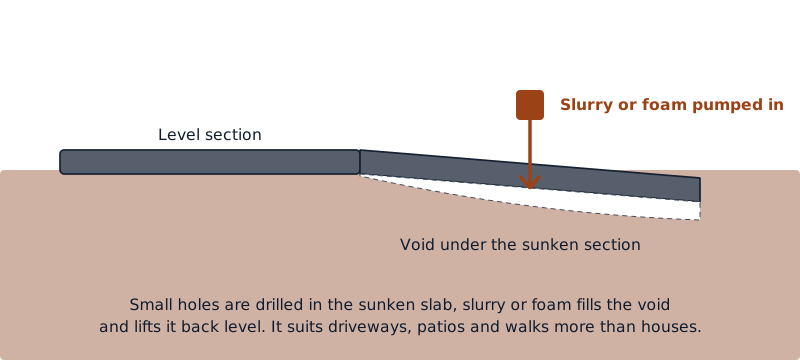
A sunken garage floor, patio or driveway slab is lifted, not topped. A contractor drills holes and pumps a cement slurry or expanding foam underneath until the slab rises back into line. That is called mudjacking or polyjacking. Pouring self-leveler on top of an outdoor slab that has dropped will not hold up to weather or tires, and it does not stop further sinking.
This Old House puts mudjacking at about $550 to $1,300 a job, and the Houston Press says the slurry needs 24 to 72 hours to cure before you drive on it. Lifting only works when the concrete is still in fairly sound shape: a slab broken into many pieces usually has to be replaced. If the soil under it was poorly compacted, it can settle again.
The detail on each method is in mudjacking and the side-by-side in polyjacking vs mudjacking. A garage floor inside the house's own slab is different: if it has dropped with the house, it is a foundation repair.
When does an uneven concrete floor need piers instead?
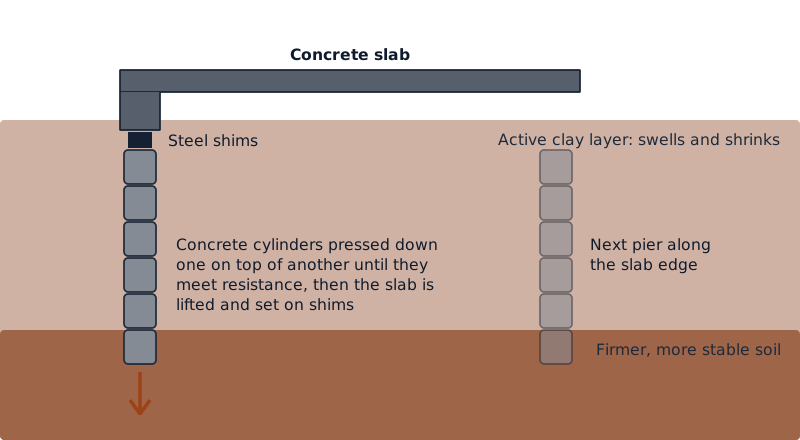
An uneven concrete floor needs piers when the slab itself has settled or heaved: the slope runs across the house, readings change over time, and cracks, sticking doors or a gap at the driveway join show the structure is moving. A contractor drives piers deep under the edge beam to firm soil, then lifts the slab back toward level before any surface work.
This is not a homeowner job. Inside the City of Houston, foundation repair runs under a building permit, and one weekly city permit report from July 2024 lists 23 foundation repair permits. Outside the city, ask your own building department.
The Houston Press puts pressed concrete piers at about $300 to $600 each and steel piers at $1,000 and up, with work inside the house adding about 15%. Once the lift is done and the readings settle, a thin self-leveling pour can take out the last small dips before new flooring. The full method is in slab foundation repair, and older homes are covered in how to level a floor in an old house.
If your readings are moving, we'll arrange a visit from a local foundation contractor who takes elevation readings across the slab and explains them. You get the price in writing before anything starts.
Questions people ask
Can you pour self-leveler over a cracked concrete floor?
You can pour self-leveler over hairline cracks that have stopped moving, once they are filled and primed. A crack that is still opening will come straight back through the new layer, because the compound bonds to the slab and moves with it. Mark the crack ends, date them, and check again after a few weeks before you pour. Growth means the slab needs attention first.
How thick can you pour self-leveling compound?
It depends on the product. Most self-leveling underlayments are made for thin layers over a fairly flat slab, and each data sheet gives a minimum and maximum depth for a single pour. For deeper hollows, use a patching mix or a deep-pour product in the low areas first, then a thin coat over the top. Going past the stated depth risks cracking and a weak surface.
Can you level a concrete floor without self-leveling compound?
Yes, for small areas. A trowel-applied patching or feathering compound fills shallow dips and feathers out to nothing at the edges, and grinding takes care of ridges. None of these will correct a floor that slopes across the room, and none of them stops a slab from moving.
Does leveling a concrete floor fix the foundation?
No. Leveling the surface only flattens the top of the slab so flooring lies flat. If the slab is settling or heaving on clay, the new surface will tilt and crack with it. Fixing the foundation means lifting the slab on piers driven deep to hard, stable soil. The surface leveling, if still needed, comes after that.
How long after leveling can you lay flooring?
You can usually walk on most self-leveling compounds within hours, but flooring has to wait until the layer has cured and dried enough for the covering you chose. Each product's data sheet gives these times, and they get longer in cool or humid weather. Ask your flooring maker what moisture reading the slab must reach.
The rest of our guides start from Houston foundation repair.
Sources
Last changed