Water that shows up on the floor after rain, and only after rain, is almost always rainwater collecting against the house, not a broken pipe. In a Houston slab home it usually gets in at the slab edge where soil, mulch or a flower bed sits too high, under the wall plate behind brick, or up through a crack when the ground beside the house is flooded. Fix where the water collects outside and most cases stop. This page sits under the guide to concrete slab foundation repair and covers one narrower job: tracing storm water that seeps through or around a slab, what you can fix yourself, and when it points to the foundation.
Is the water coming up through the slab, or in at the wall?
Most of the time it comes in at the wall, not through the middle of the concrete. Water that wets carpet or baseboards along an outside wall usually runs in where the wall meets the slab edge. Water rising through the center of a room, far from any outside wall, is rarer and more often a crack, a plumbing opening or soaked ground pushing up from below.
The pattern tells you a lot. Look at where the wet spot starts and which way it spreads.
| Where it's wet | What it usually means |
|---|---|
| A strip along an outside wall | Water entering at the slab edge or under the wall framing |
| One corner, after heavy rain only | A downspout, a low spot or a bed piled against that corner |
| A line across the floor | A crack in the concrete slab letting water up |
| Around a tub, toilet or pipe opening | Water following the plumbing penetration through the slab |
| Damp all over, no clear edge, worst in humid weather | Condensation or moisture vapor, not liquid water |
| Wet with no rain at all | A plumbing leak; see the slab leak symptoms |
If the floor gets wet on dry days too, stop here and treat it as a possible leak. Rain-only water is a drainage problem first.
How does rainwater get under a concrete slab foundation in Houston?
Rainwater reaches a slab when the ground around the house holds it instead of shedding it. A slab foundation sits on the soil with no basement walls to keep water out, so anything pooling against the edge has a short path in. Flat lots, heavy clay, gutters that dump at the corners and beds built up over the slab edge are the usual causes in Houston.
The clay plays a part. The USDA describes the Lake Charles clay found across the Houston area as 45 to 60% clay that opens cracks up to about 2 inches wide in dry spells. Water enters that soil fast while it is cracked and very slowly once it is wet. So the first big storm after a drought can send water down the cracks beside the house and under the slab edge, while later storms mostly pond on the surface.
The common entry routes:
- Grade too high. The residential code used in Texas (R404.1.6) asks for the foundation to stand at least 4 inches above finished grade where there is brick veneer and 6 inches elsewhere. Beds and mulch built up over time often bury that edge.
- Grade sloping the wrong way. Section R401.3 asks for the ground to fall at least 6 inches within the first 10 feet from the house. Many older Houston lots have settled flat or toward the slab.
- Blocked weeps. Brick veneer is built with small open joints at the bottom, which the Brick Industry Association shows at 24 inches apart, to let water out from behind the brick. Soil or mulch over them traps water against the wall base.
- Pressure from saturated ground. When the soil beside the house is full of water, the weight of that water, called hydrostatic pressure, pushes it through any crack or gap in the concrete.
- Flooded streets and yards. In a storm like Harvey, which dropped 47.4 inches in 4 days at Clear Creek and I-45 according to the Harris County Flood Control District, ground water and surface water simply rise around the slab.
How can you find where the water is coming from?
You can usually trace it yourself in a day or two by watching the house in the rain and testing one source at a time. Note exactly where the floor gets wet, walk the outside wall opposite that spot during a storm, and look for water pooling, a downspout outlet, a buried edge or blocked weeps. Then test each suspect with a garden hose on a dry day.
Work through it in this order:
- Mark the wet area. Pull back carpet if you can and photograph the wet edge, with the date and how much it rained.
- Go outside during the rain. Stand at the wall nearest the wet spot. Note any water standing within a few feet of the house, and where the downspouts empty.
- Check the slab edge. You should see a band of bare concrete between the soil and the brick or siding. If you can't, the grade or a bed is too high.
- Check the weeps. Find the small gaps in the bottom row of brick. Clogged ones are a likely entry point.
- Hose test on a dry day. Run water on one spot at a time for 20 to 30 minutes: the bed, then the downspout outlet, then the wall. Watch inside for the wet spot to return.
- Rule out the plumbing. If nothing outside makes the floor wet, run the water meter test described on the slab leak page before you suspect the slab itself.
Write down what made the floor wet. A contractor can do far more with "the northeast corner floods when the downspout runs" than with "it gets wet sometimes."
What can you fix yourself after a storm?
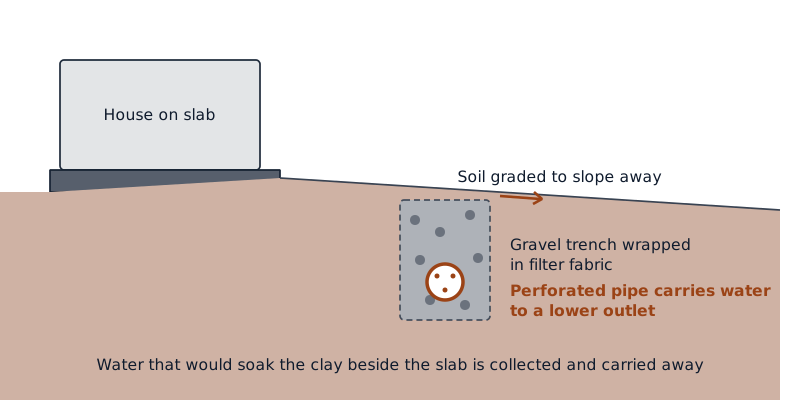
You can fix most rain-only water problems yourself if they start outside. Pull soil and mulch back so the slab edge shows, extend downspouts well away from the house, clear blocked weeps, and reshape beds so the ground falls away from the wall. These cost little, and they often stop the water entirely. Regrading a whole yard, or anything involving drains, is a bigger job.
- Lower the beds. Dig the soil back until there is a visible band of concrete above it. Edging stones can hold a bed back from the wall.
- Move the downspouts. Add extensions or splash blocks so roof water lands several feet out, not at the slab corner.
- Clear the weeps gently. The Brick Industry Association's maintenance note says clogged weeps should be opened carefully so the flashing behind them isn't damaged. Use a thin stick or wire, not a drill.
- Adjust the sprinklers. Heads spraying the wall or a zone running after a storm add water you don't need.
- Dry the inside. Lift wet carpet and pad, run fans and dehumidify. Flooring left wet against a concrete slab is where mold and odors start.
Stop before you seal the slab from inside or cut into the floor. A coating on top of wet concrete tends to trap moisture under the flooring rather than stop it. For water that keeps pooling after the beds and gutters are sorted, the guide to foundation drainage in Houston explains grading, swales and buried drains, and foundation drain vs French drain covers which kind of drain suits a slab.
When does water through the slab mean foundation damage?
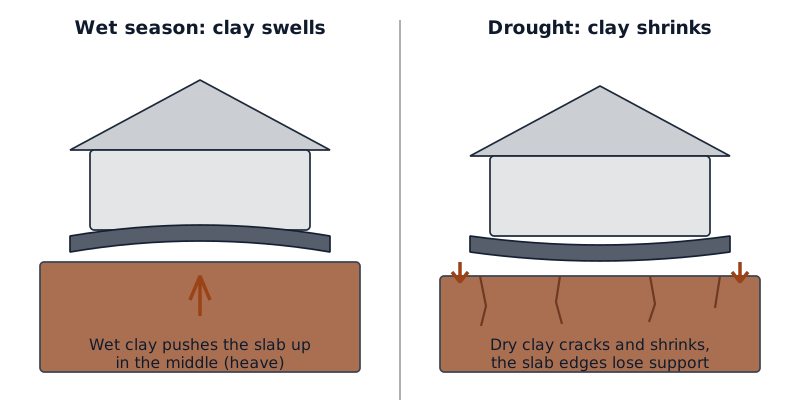
Water through a slab after rain becomes a foundation question when it comes with movement. New or widening cracks in the floor, a crack where one side sits higher than the other, doors that stick after wet weather, or gaps opening at the base of walls all suggest the clay under the slab is swelling and shrinking with the water. Then fixing the drainage alone may not settle it.
On Houston clay, water collecting at one side of the house wets that side more than the rest. Clay that swells can lift that part of the slab, a movement called heave, and the drier side stays put. The guide to foundation heave repair covers that problem, and concrete slab cracks explains how to read a crack's width and shape.
A wet floor with no cracks, no sticking doors and a level feel underfoot is very likely drainage only. A wet floor with any of those signs is worth having measured, because a contractor's floor elevation survey shows whether the slab has actually moved.
Who should you call about water coming up through a slab?
Call the trade that matches what you found. Water only in rain with no movement signs points to a drainage or landscape contractor. Water on dry days points to a plumber first. Water plus new cracks, sloping floors or sticking doors points to a foundation contractor, who measures the slab and says whether drainage, foundation work or both are needed.
If the slab has moved, any lifting or pier work inside the City of Houston needs a building permit, so it is planned and filed before work starts. Ask anyone who quotes to explain what the water is doing and why their fix addresses it, not just the repair they sell. Describe what you traced and send your photos through the foundation repair quote page, and we'll arrange a visit from a local foundation contractor. An estimate covers a look at the slab, the floor levels and the drainage around it, and you get the price in writing before any work starts.
Questions people ask
Can you waterproof a concrete slab from the inside?
Not reliably when water is coming from outside. Sealers and coatings on top of a concrete slab can slow moisture vapor under new flooring, but they don't stop water pushed through a crack by saturated ground, and trapped water can lift the coating or the floor. Fix the grade, gutters and weeps first, then use an interior sealer only as a backup under flooring if the slab still tests damp.
Does a slab have a moisture barrier underneath?
Many newer slabs are poured over a plastic sheet and a layer of sand or gravel that slow moisture wicking up from the soil. University of Wisconsin extension guidance notes a granular layer under a slab can act as a capillary break. Older slabs may have neither, or a torn sheet. You can't check from above, but flooring that cups or lifts in a room with no visible leak suggests vapor is coming up.
Can a French drain stop water coming up through the slab?
Sometimes, when the problem is water collecting in the ground beside the house that surface fixes can't move. A drain only works with enough fall to an outlet, which is hard to find on flat Houston lots. Try regrading, downspout extensions and lowering beds first. They solve most rain-only cases at a fraction of the cost and tell you whether a buried drain is needed at all.
Is water coming up through the floor after a flood different?
Yes. When a street or yard floods, water rises around the whole slab and can come up through every crack, joint and pipe opening at once, and no yard fix stops that. After a flood, dry the house out, photograph everything and check the slab for new cracks once it dries. Flood-prone streets need a different plan from a wet corner caused by a downspout.
This guide is one of many on the foundation repair guide for Houston.
Sources
- 2021 International Residential Code as adopted in Texas, Chapter 4 (R401.3 and R404.1.6)
- Brick Industry Association, Technical Note 28, Brick Veneer Wood Stud Walls
- Brick Industry Association, Technical Note 46, Maintenance of Brick Masonry
- University of Wisconsin Cooperative Extension, Concrete materials and properties (Kammel), hosted by Wisconsin DATCP
- USDA NRCS, Lake Charles soil series description
- Harris County Flood Control District, Hurricane Harvey immediate flood report
- City of Houston weekly building permit report, July 2024
Last changed