A crack in a wall means something moved further than the wall finish could stretch. That is all a crack proves on its own. The real question is what moved: the paint and tape, the wood framing behind it, or the foundation under the house. Most cracks in Houston homes come from the first two and are cosmetic. A smaller number come from the slab or piers shifting on clay soil, and those are the ones that matter. This page shows how to tell which one you have, and what fixing it involves. For repair methods and prices, our foundation crack repair guide is the place to start.
What does a crack in a wall actually mean?
A crack in a wall means the wall was put under more strain than its surface could take, so it split to relieve that strain. Gypsum board, plaster and joint compound are stiff and brittle, so they show movement before anything else in the house does. It shows movement happened, not where it came from.
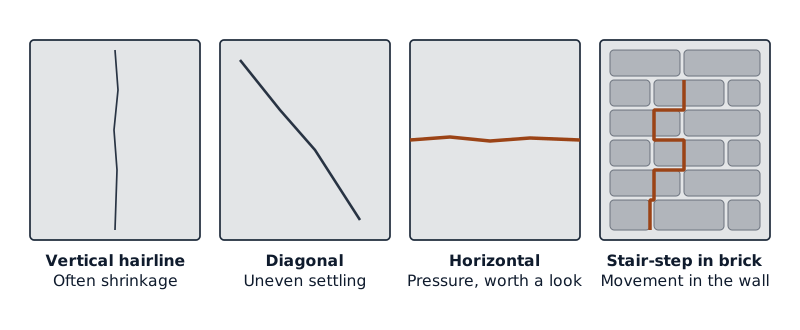
It has three possible sources:
- The finish. Paint, tape and joint compound shrink as they dry, or were applied thinly over a seam.
- The framing. Lumber shrinks as it dries out, and roof trusses rise and fall with moisture.
- The foundation. The slab or the piers move with the soil underneath, and the whole wall above goes slightly out of square.
The first two are common, slow and harmless, and they produce most of the hairline cracks people notice. The third is the one worth paying for an inspection to rule out. If you want to match a crack shape to a likely cause, our guide to types of cracks in walls lays out each pattern one by one.
Which part of the house moved: the finish, the framing or the foundation?
You can usually tell which part moved by looking at what else is happening around the crack. Finish cracks stay fine, follow seams and stay put. Framing cracks show up in a new or recently remodeled house, often over doors or at the ceiling line. Foundation cracks come with company: doors that stick, gaps at trim, cracks outside on the same side, and widths that change through the year.
| What you see | What it usually means | What moved |
|---|---|---|
| A fine, straight line along a taped seam, no wider over months | The tape or compound let go | The finish |
| Nail or screw heads popping through, small cracks in a new house | Lumber drying and shrinking away from the board | The framing |
| A crack at the wall to ceiling corner that opens and closes with the seasons | Roof trusses lifting as their chords change moisture | The framing |
| Diagonal cracks from door or window corners, with a door that rubs | The wall is racking out of square | Likely the foundation |
| Several cracks on one side of the house, plus brick cracks outside | One part of the slab rising or dropping | Likely the foundation |
Building Science Corporation explains that drying studs get thinner and pull away from the drywall, and that truss uplift can only be allowed for, not prevented. Neither involves the slab, and both are fixed with drywall work. If cracks show up in several rooms, our page on cracks in interior walls shows how to map them.
What does it mean when a wall crack keeps coming back?
A crack that returns after it was filled means the movement behind it has not stopped. If the wall keeps shifting, the patch splits along the same line. In Houston that usually means the soil under the slab is still drying and swelling, so the foundation is moving up and down with the weather.
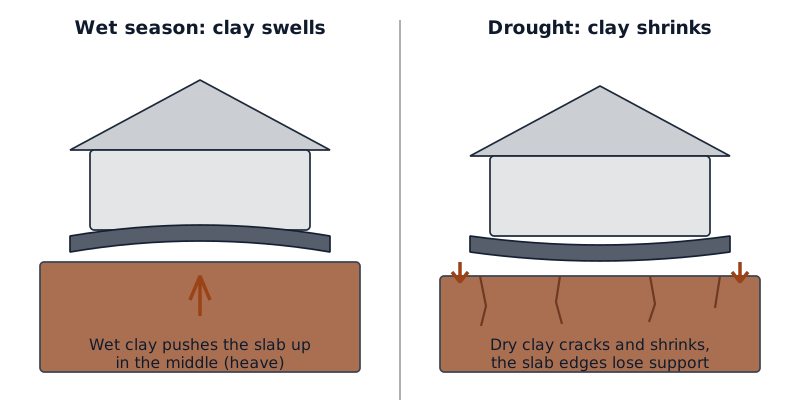
Heavy clay is the reason. The USDA's Lake Charles series, mapped mainly between the Colorado and Trinity rivers, is 45 to 60% clay. Dried out, its surface opens in gaps 1/2 to 2 inches wide that stay open 60 to 90 days in most years. Ground that shrinks that much lets a slab drop each summer and rise after the rains.
So timing is a clue. A crack that opens in late summer and closes after fall rains tracks the soil. One that grows every month, whatever the weather, points to ongoing settlement or heave.
For a sense of scale, BRE Digest 251 groups wall cracks up to 5 mm wide, a little under 3/16 inch, as aesthetic damage. Its guidance adds that widening can push a crack into a more serious class. Growth tells you more than width.
Does a horizontal crack in a wall mean the same thing in Houston as up north?
No. Most online warnings about horizontal cracks are written for homes with a basement, where soil presses sideways on a buried concrete or block wall and a horizontal crack can mean the wall is bowing inward. Houston has almost no basements. Homes here sit on a slab or on pier and beam instead.
In a slab home, a horizontal crack in an interior wall usually follows a drywall seam, since boards are often hung sideways with a joint partway up the wall. A horizontal crack in exterior brick veneer is more often worth a look, since it can sit over a sagging steel lintel or where the veneer meets the slab edge. A horizontal crack in the slab itself is a different subject, covered in our vertical vs horizontal foundation cracks guide.
How does moisture cause cracks in walls?
Moisture causes cracks in walls in two ways. Outside, it makes the clay under the foundation swell when wet and shrink when dry, which lifts and drops parts of the slab. Inside, a leak or high humidity softens and swells drywall, wood trim and plaster, which then shrink and split as they dry. The first is a foundation issue. The second is a water issue.
Staining, bubbling paint or soft board near the crack, or a crack beside a bathroom or water heater closet, points to water inside rather than soil movement.
A leaking pipe under the slab can wet the soil in one spot and heave that part of the slab. Our list of slab leak symptoms helps you check for that. Waterproofing a wall or patching the crack does nothing until the water source is found and stopped.
What does fixing cracks in walls involve?
Fixing cracks in walls means fixing the cause first and the surface last. A finish or framing crack needs only drywall repair: cut out loose material, tape, compound, sand and paint. A crack caused by the foundation needs the foundation looked at, and if it is moving, leveled or supported, before any patch will hold. Patch first and the crack simply comes back.
- Measure and date it, with a pencil mark at each end and a photo beside a ruler.
- Watch it for a season, and look for sticking doors, gaps at trim and brick cracks outside.
- Fix any water first, from a leak or poor drainage near the house.
- Get a foundation check if it grows or comes with those other signs.
- Repair the foundation if needed. In the City of Houston, foundation repair needs a building permit. One week's city permit report in July 2024 listed 23 of them.
- Patch and paint last, once the foundation work is finished and the walls are in their final position.
Our guide to filler for cracks in walls covers which product to use on drywall, plaster and trim gaps.
When does a crack in a wall mean you should call a foundation contractor?
Call a foundation contractor when a wall crack is growing, wider than about 3/16 inch, wider at one end than the other, or arriving with doors that stick, floors that slope or cracks in the brick outside. A single fine crack that stays the same through a summer is a drywall job, not a foundation job.
An inspection measures floor levels across the house to show whether the slab or piers moved. The Houston Press guide puts foundation inspections in the area at around $600 on average, in a $300 to $1,000 range. This Old House lists a structural engineer's report at $500 to $1,000 if you want an independent opinion.
When we'll arrange a visit, a local foundation contractor looks at the cracks, takes level readings, checks drainage around the house and explains what they think is moving. You get the price in writing before any work starts. If you want a professional opinion on what your cracks mean, book a foundation inspection or ask for a quote.
Questions people ask
Do cracks in walls mean the house is unsafe?
Almost never. Most cracks in walls are cosmetic, and even cracks from foundation movement in Houston rarely make a home unsafe to live in. They affect doors, windows and finishes long before they affect stability. The exception is a crack that is opening fast, with walls or ceilings visibly sagging, which needs a professional look the same week.
Are cracks in walls normal in a new house?
Yes, small ones are common in the first year or two. New lumber dries out and shrinks, which pulls framing away from the drywall and pops nails and seams. These cracks are usually fine, straight and near doors, windows or ceiling corners. If they keep growing after the second summer, or show up with sticking doors, have the foundation checked.
How much does it cost to find out what a wall crack means?
A foundation inspection in the Houston area usually costs $300 to $1,000, with around $600 typical, according to the Houston Press guide. A structural engineer's report runs about $500 to $1,000, per This Old House. Watching and measuring the crack yourself for a season costs nothing and often answers the question first.
The rest of our guides start from Houston foundation repair.
Sources
- BRE Group, assessing cracks in houses (summary of BRE Digest 251)
- Building Science Corporation, RR-0107 Drywall, Wood and Truss Uplift
- USDA NRCS, Lake Charles soil series description
- This Old House, foundation repair cost guide (October 2026)
- Houston Press, guide to foundation repair in Houston (2026)
- City of Houston weekly building permit report, July 2024
Last changed