To repair cracks in exterior walls, match the fix to the wall. Hairline cracks in stucco take a thin slurry or a coat of paint. Gaps in siding and trim take a flexible exterior sealant, and split boards get replaced. Cracked mortar in brick gets repointed. Before any of that, decide whether the crack is only in the skin of the wall or whether the house moved underneath it, because no patch holds over a foundation that is still moving. This guide walks through each wall type step by step. For cracks in the slab itself, start with foundation crack repair in Houston.
How do you repair cracks in exterior walls?
You repair cracks in exterior walls in four steps: work out what moved, clean the crack back to sound material, fill it with a product that behaves like the wall around it, and keep water out afterward. The material matters most. Stucco wants a cement-based patch, siding wants sealant or a new board, and brick wants mortar. Using caulk everywhere is the most common mistake on Houston houses.
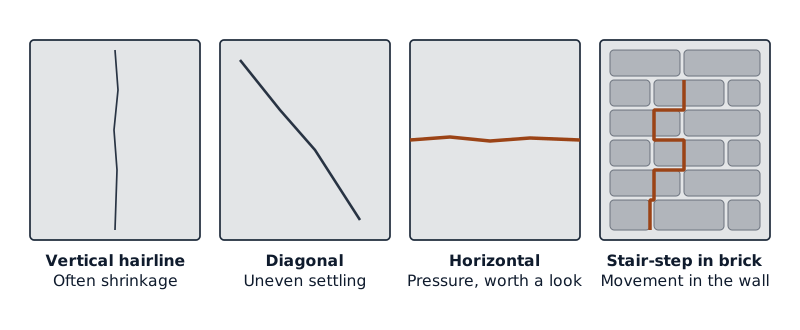
Before you patch, mark each end of the crack in pencil, note its widest point and photograph it. Check again in a month. A crack that grows is not ready to patch. Look at the drywall and door frames on the inside of the same wall too: cracks that line up inside and out point to movement, not weathering. Finish every repair with paint, because a painted patch sheds water and a bare one soaks it up.
Which cracks in exterior walls are serious?
Cracks in exterior walls are serious when they are wider than about 1/4 inch, wider at one end than the other, running diagonally from the corners of windows and doors, stepping through brick, or horizontal across a wall. Those patterns usually mean the slab or piers under that wall have settled or heaved. Hairline cracks that stay the same width for months are usually surface cracks you can patch yourself.
| What you see outside | What it usually means | Who fixes it |
|---|---|---|
| Fine web of hairline cracks in stucco | Shrinkage or weathering of the finish coat | You, with a slurry or paint |
| Gap between siding and window trim | Old sealant failed, wood moved with humidity | You, with exterior sealant |
| Split or soft siding board | Moisture damage or age | You or a carpenter, by replacing the board |
| Diagonal crack from a window corner | The wall below moved | A foundation contractor should look first |
| Horizontal cracks across stucco or brick | Movement or pressure on the wall | A foundation contractor or structural engineer |
| Crack wider at the top than the bottom | One part of the house dropped | A foundation contractor |
Not sure which row fits? See when foundation cracks are worth worrying about.
How do you repair cracks in stucco walls?
You repair hairline cracks in stucco with a thin slurry made from the finish coat ingredients, brushed on and rubbed into the cracks, or with a good coat of exterior masonry paint. Larger cracks have to be cut out and patched in layers. The National Park Service's guidance on stucco repair says commercial caulking is not suitable for hairline stucco cracks, because it weathers differently and holds dirt, so the repair stays visible.
For a small DIY stucco repair:
- Tap around the crack with a wooden mallet or the handle of a screwdriver. A hollow sound means the stucco has lost its grip on the wall, and that area needs cutting back, not filling.
- For hairline cracks, mix a creamy slurry from a stucco patching product, wet the wall lightly, and work it into the cracks with a sponge or float. Paint once it has cured.
- For a wider, stable crack, open it into a slight V with a masonry chisel, clean out the dust, dampen the edges, and pack in a stucco patch. Build thick repairs in more than one layer.
- Keep the patch shaded and damp while it cures. The Park Service warns that stucco cracks when it dries too fast, which is easy to do on a Houston summer afternoon.
Call a plasterer when the stucco bulges, sounds hollow over a wide area, or shows water stains. Most larger stucco repairs need a professional to blend in.
How do you fix cracks and gaps in siding and trim?
You fix cracks and gaps in siding by sealing the joints and replacing the damaged boards. Gaps where siding meets window and door trim, corner boards or the slab edge get cleaned out and filled with a paintable exterior sealant. A board that is split, swollen or soft gets replaced, because sealant over rotten wood just traps moisture behind it. Then the area is primed and painted.
Wood siding is common on older Houston homes: the City of Houston's Heights design guidelines describe its houses as mostly wood siding on pier and beam foundations. Newer houses often use fiber cement boards, which can crack at nails and joints when the frame moves.
A few practical points:
- Cut out old caulk first. New sealant over cracked old sealant soon fails.
- Leave drainage gaps alone. The gap along the bottom edge of lap siding and above flashing lets water out. Sealing it holds water in the wall.
- Watch for patterns. If boards keep opening at the same corner, or trim pulls away more each year, the frame is moving. On a pier and beam house that often points to the piers. Our page on pier and beam foundation repair covers that.
What about cracks in brick and concrete block exterior walls?
Cracks in brick and block walls get repaired with mortar, not caulk, except at expansion joints and where brick meets a window or door frame, which take flexible sealant. Small cracks in mortar joints are raked out and repointed. Cracks that step up through the joints or split the bricks usually mean the slab moved, and the foundation comes first.
Most brick on Houston houses is veneer: one layer of brick standing in front of a wood frame, with an air space behind it. Water that gets through the brick drains down that space and out through weep holes, the small open gaps along the bottom course. When you repair a brick wall, keep those weeps open. Never caulk or mortar them shut, and keep soil and mulch below them.
For repointing step by step, see cracks in brick walls, and for block walls, cracks in concrete block walls.
Why do exterior wall cracks come back after you fix them?
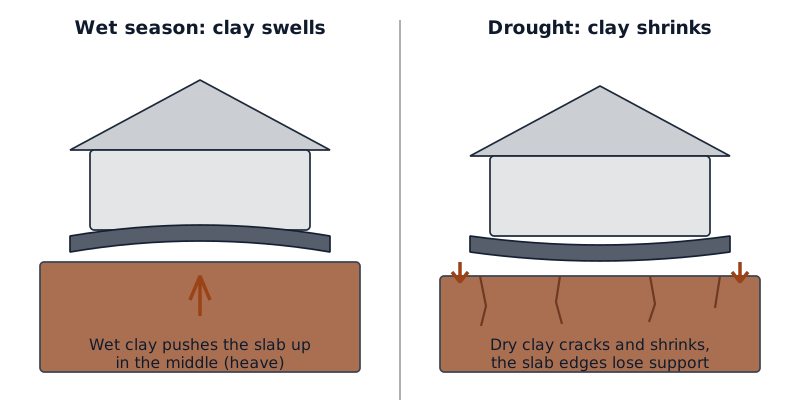
Exterior wall cracks come back when the cause is still there. The usual causes are moisture getting behind the wall, a patch that is stiffer than the wall around it, or a foundation that is still moving. On Houston's clay soils the ground shrinks and swells with the seasons, so a crack that closes in a wet spring can reopen in a dry August.
The USDA describes Lake Charles clay, a common soil in the Houston area, as cracking 1/2 to 2 inches wide at the surface when dry. When it dries under one side of a house and stays wet under the other, the walls flex and a rigid patch cracks again.
To give a repair the best chance:
- Keep the soil around the house evenly moist through dry spells, for example with a soaker hose for the foundation.
- Fix gutters and downspouts that dump water against the wall.
- Don't rely on a clear coating over cracked walls as waterproofing. Water gets in through the cracks themselves, and Houston homes have no basement to show you where it ends up, so it rots framing quietly instead.
When do exterior wall cracks need a foundation contractor?
Exterior wall cracks need a foundation contractor when they come with signs inside the house: doors that stick, sloping floors, cracks in the drywall above door frames, or windows that won't latch. They also need one when a crack is wider than about 1/4 inch, keeps growing, or is horizontal. Patching the wall won't fix any of these. The support underneath has to be measured first.
We'll arrange a visit: a local foundation contractor walks the outside, measures the floor levels inside and looks at drainage and trees near the house. You then get a written estimate of the cause, the proposed repair and its price, before any work starts.
Foundation repair inside the City of Houston needs a building permit. Ask any contractor who will pull it. Cities around Houston set their own rules, so check with your city's building department.
If the cracks are serious, a foundation inspection is the sensible next step.
Questions people ask
Can I use caulk to repair cracks in exterior walls?
Use caulk only on joints that move: where siding meets trim, around windows and doors, and at expansion joints in brick. Don't use it on hairline cracks in stucco or in mortar joints, where it weathers differently, collects dirt and stays visible. Choose a paintable exterior sealant.
Are hairline cracks in exterior walls normal?
Yes, hairline cracks are common in stucco and brick, and many come from shrinkage and temperature swings. They are normal if they stay hairline and don't grow over a few months. Mark the ends, photograph them, and check again after a dry spell and after heavy rain.
Are horizontal cracks in an exterior wall worse than vertical ones?
Usually, yes. Vertical hairline cracks often come from shrinkage or expansion and are mostly cosmetic. Horizontal cracks across stucco or brick suggest the wall is being pushed, bowed or pulled, often by movement in the structure behind it or below it. Have a foundation contractor or a structural engineer look at a horizontal crack before you patch it.
Should I fix the foundation or the wall crack first?
Fix the foundation first if it has moved. A patch over a crack that is still opening will crack again, sometimes within weeks. Once the foundation is stable, the wall cracks can be repaired and painted for good. If an inspection shows the foundation is sound, you can patch the wall straight away.
For the wider picture, start with Foundation Repairs Houston Quotes.
Sources
Last changed