A normal foundation crack looks like a thin pencil line in the concrete: hairline width, flush on both sides, often vertical or wandering, and the same size every time you look. You find them in garage floors, along the exposed edge of a slab, and under flooring when it comes up. Those are mostly concrete shrinking as it cured. Below: what normal cracks look like in each spot on a Houston house, why so many online photos show basements, and how to photograph your own crack. For how cracks get fixed, see foundation crack repair.
What do normal foundation cracks look like?
Normal foundation cracks are thin, shallow-looking lines you could cover with a strand of hair or the edge of a credit card. Both faces of the concrete sit at the same height, the line has no wide end and narrow end, and the edges are dry. They may run straight, wander like a river on a map, or branch in a loose web. What they share is that nothing about them changes month to month.
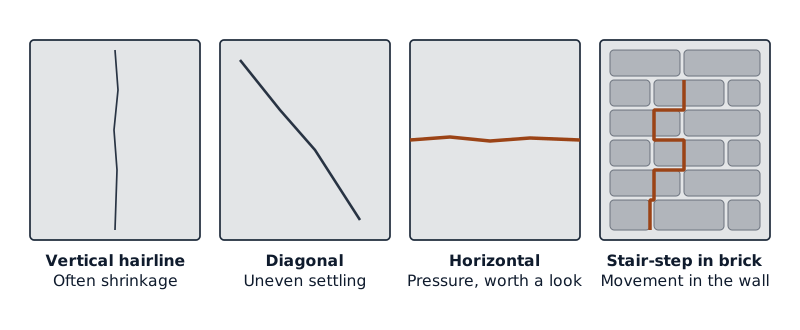
This Old House describes hairline cracks as surface cracks that form as concrete cures and shrinks, often within the first couple of years, in new and older homes alike. Vertical hairlines are also commonly tied to ordinary settling as a house adjusts.
What does a normal crack look like on a Houston slab?
On a Houston slab, a normal crack is a fine line in the garage floor, a short vertical hairline on the exposed edge of the slab outside, or a thin line found under carpet or tile during a remodel. The concrete on each side sits flat and level. Most homes built here since the 1960s are slab on grade, so these are the cracks you will actually see.
Here is what to expect in each spot:
| Where you look | What a normal crack looks like | What would change the picture |
|---|---|---|
| Garage floor | Thin lines, sometimes meeting at a sawn or tooled groove | A step at the crack, or a crack you can slide a coin into |
| Slab edge outside | Short vertical hairlines in the concrete face above the soil | A corner piece breaking away, or a crack running sideways |
| Under carpet or tile | A thin line, sometimes crossing the room | Tile cracked in a straight run, or the floor dipping toward the line |
The garage shows your slab best, because nothing covers it. A web of very fine, shallow lines across the surface is often just the top layer drying fast during the pour; plastic shrinkage cracks in a concrete slab explains that pattern.
As for cracks in slab foundation and when to worry: worry when the line has turned into a gap, when one side has dropped, or when it lines up with cracks in the walls above.
What do non-structural cracks in walls look like?
Non-structural cracks in walls look like fine straight lines along drywall tape joints, small hairlines running off the corner of a door or window frame, or a thin crack through a single brick or mortar joint. They don't widen, they don't come back fast after patching, and the doors and windows near them still open and close normally.
The common non-structural types of cracks in walls are:
- Tape joint lines. A dead-straight crack where two sheets of drywall meet, often on ceilings. Usually the tape or mud letting go.
- Short corner hairlines. A thin crack, an inch or two long, leaving the top corner of a door frame.
- Mortar hairlines. A fine line in one or two joints of brick veneer, not a pattern climbing the wall.
Brick tells you more than drywall. A crack that climbs the mortar joints in a staircase shape over several courses is a different picture; stair-step cracks in brick covers what that pattern means.
What does a serious foundation crack look like?
A serious foundation crack looks like a gap rather than a line. It is wider at one end, one side sits higher than the other, or it keeps getting longer. It often has company: diagonal cracks above doors, gaps at the trim, or doors that stopped latching. This Old House treats a crack wider than 1/4 inch as one possible sign of a structural problem.
The full checklist of warning signs, and a simple way to measure a crack at home, is on foundation cracks: when to worry. This page sticks to what the cracks look like.
Are horizontal foundation cracks always bad?
Horizontal foundation cracks are not always bad, but most of the frightening photos you see of them show basement walls, which Houston homes almost never have. In a basement, a horizontal crack can mean soil pressure pushing the wall inward. On a slab, a short horizontal line low on the exposed edge can be minor. A long one, or one with a bulge or step, needs a look.
This Old House calls horizontal cracks often the most concerning type, because they point to soil pressure strong enough to bow a wall. That is a basement and block-wall problem. On a Houston slab, the closer equivalent is a crack that runs sideways along brick veneer or across the slab edge with one side out of line. Vertical vs horizontal foundation cracks goes into the difference in direction.
Why don't the pictures online look like my house?
Most crack photos online come from parts of the country with basements, poured concrete walls and block foundations. A Houston house is usually a slab on grade sitting on clay, or an older pier-and-beam home. So you are comparing your garage floor with someone else's basement wall, and the shapes, causes and fixes are different.
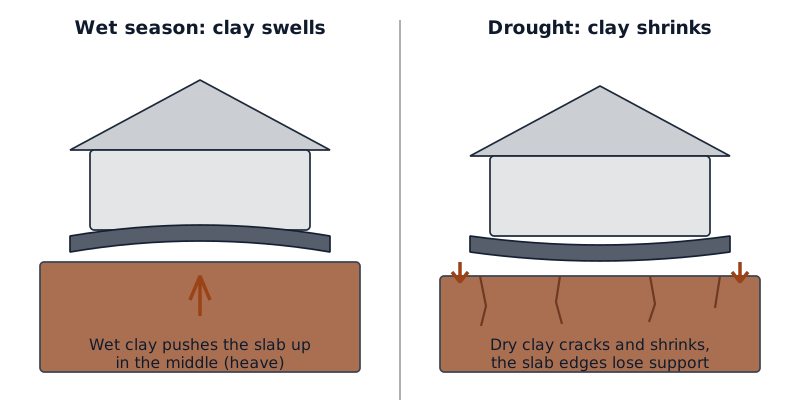
The clay matters too. The USDA describes Lake Charles clay, common across the Houston area, as cracking open 1/2 inch to 2 inches wide at the surface when it dries. In a dry summer you may see that gap in the soil right beside your slab. That is the ground, not the foundation, but it shows how much the soil under your house moves with moisture.
How do you photograph a foundation crack so it can be compared?
Take one wide photo that shows where the crack is on the house, then a close-up with a ruler or coin beside it, both from the same spot every time. Shoot in daylight or with a light held low to the side, so the edges cast a shadow and any step shows up. Name each file with the date and place.
A good set looks like this:
- Overview. Stand back far enough to show a door, corner or window for reference.
- Close-up with scale. A ruler or coin flat against the surface, square to the camera.
- Side light. A flashlight held low and to one side shows an offset that flat light hides.
- Repeat. Same spot, same angle, every few weeks and after a big rain or dry spell.
Photos like these let a contractor see what kind of visit you need. They don't replace one: whether a slab has moved is measured on site with floor levels, which a foundation inspection covers.
What does a repaired crack look like before and after?
Before repair, the crack is an open line or gap. After an injection repair, you usually see a smooth strip of sealant along the line where small ports were fixed and then removed, often a little darker or lighter than the concrete. A cosmetic repair can be ground and blended. A repaired crack that opens again beside the patch means the slab is still moving.
The Texas Department of Transportation notes that, depending on the epoxy, cracks as narrow as 0.002 inch can be injected, though cracks under 0.005 inch are often hard to fill. That is why some very fine hairlines are simply left and watched. This Old House puts crack filling at about $250 to $800. Sealing a crack also helps keep moisture out, but it is not waterproofing for the whole slab, and it does nothing if the soil underneath is still shifting. Epoxy injection for foundation cracks covers the method.
When the crack is a symptom of movement, the repair is piers and leveling, not just filling. In the City of Houston that work needs a building permit, so any contractor quoting it should include one.
Questions people ask
Can I send pictures of a crack instead of having someone visit?
Pictures help, but they rarely settle the question. A photo shows the shape and width of a crack, not whether the slab around it has moved. That is checked on site by measuring floor levels across the house. Send clear photos with your enquiry so the right person comes out, and expect a written quote only after someone has looked.
Is it normal for a new house to have foundation cracks?
Yes, thin cracks in a new slab are common. Concrete shrinks as it cures, and This Old House notes hairline cracks often appear within the first couple of years. Photograph and date them early, while the house is new, so you have a baseline. A crack that widens, steps or spreads into the walls is not part of normal curing.
Do cracks in slab foundation always mean repair?
No. Most hairline slab cracks only need watching, and some get sealed when flooring is replaced. A slab needs repair when cracks come with movement: one side lower, gaps opening, doors sticking, or floors sloping. Then the cause gets fixed with piers or leveling, and the cracks are sealed afterward.
Do the pictures of normal foundation cracks apply to pier-and-beam homes?
Only partly. A pier-and-beam home has no slab under the living space, so look at the concrete piers, the beams and the floor above. Hairlines in a pier are usually minor. A pier that leans, has split, or has lost contact with the beam is a sign the support has shifted and needs a look.
The rest of our guides start from foundation repair in Houston.
Sources
- This Old House, foundation cracks: what is normal and when to worry (April 2026)
- This Old House, foundation repair cost guide (October 2026)
- Texas Department of Transportation, Concrete Repair Manual, crack repair by pressure-injected epoxy
- USDA NRCS, Lake Charles soil series description
- City of Houston weekly building permit report, July 2024
Last changed