Yes, you can fix many foundation cracks from the outside. On a Houston slab, the part you can reach is the concrete edge showing between the soil and the brick or siding. A narrow crack there that has stopped moving can be cleaned out, sealed with a flexible concrete sealant or patched with repair mortar in an afternoon, for little more than the cost of materials. What sealing from outside can't do is stop a slab that is still moving. This guide covers the exterior work itself; for how every kind of crack gets repaired, start with foundation crack repair in Houston.
Can you fix foundation cracks from the outside?
You can fix a crack from the outside when it is in concrete you can see and reach, it is narrow, and it has stopped growing. Sealing it keeps moisture and insects out of the slab edge and stops the crack collecting dirt and widening with each wet and dry cycle. If the crack is moving, outside sealing only hides it for a season, and the fix has to happen under the house instead.
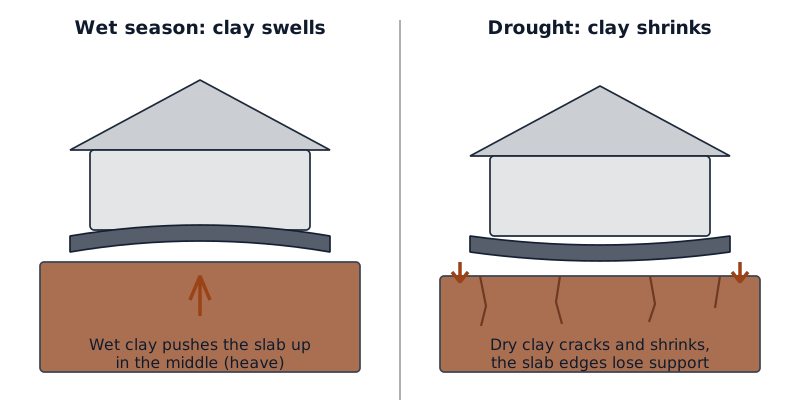
Most Houston homes built since the 1960s sit on a slab on grade, with a thickened edge, often called the perimeter beam, carrying the outside walls. Only the top few inches of that beam are visible. Older homes in neighborhoods like the Heights sit on pier and beam, where the "outside" of the foundation is the perimeter beam and the piers behind the skirting.
Almost no Houston house has a basement, which matters here. Much of the advice online about fixing cracks from the outside is written for basement walls, where a crew digs down the full height of the wall to waterproof it. That job rarely applies in Houston.
Which outside foundation cracks can you fix yourself?
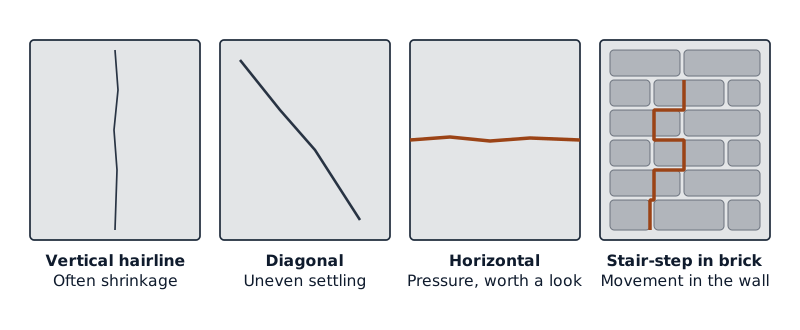
You can usually handle hairline cracks and cracks up to roughly 1/8 inch wide in the slab edge, provided both sides sit flush and the crack hasn't grown over a few weeks of watching. Leave alone any crack with one side higher than the other, any crack wider than about 1/4 inch, and horizontal cracks running along the beam. Those suggest movement or pressure, and they need someone to measure the house.
A simple way to sort what you're looking at:
| What you see outside | Likely cause | Fix it yourself? |
|---|---|---|
| Hairline cracks in the slab edge, flush both sides | Concrete shrinking as it cured | Yes, seal it |
| Crack up to about 1/8 inch, not growing | Shrinkage or minor settling | Yes, seal and watch it |
| Small piece broken off a slab corner | Stress at the corner, often where the concrete is thin | Usually, with patch mortar |
| Crack with one edge higher, or over about 1/4 inch | The slab is moving | No, have it measured |
| Horizontal cracks along the beam face | Pressure or rotation in the beam | No, have it measured |
| Stair-step cracks in the brick above a crack | Movement reaching the walls | No, have it measured |
The thresholds are a guide, not a test. The warning signs are set out in full under when to worry about foundation cracks.
How do you seal a crack in the outside edge of a slab?
You seal an outside slab crack by digging the soil back a few inches, cleaning the crack to sound concrete, letting it dry, and filling it with a polyurethane concrete sealant or a two-part epoxy paste. Choose a flexible sealant for a crack that opens and closes with the seasons, and a rigid epoxy or polymer-modified patching mortar for a dry, stable crack you want bonded shut. The job takes a few hours plus curing time.
- Expose the crack. Pull soil and mulch back from the slab edge so you can see where the crack ends, and check whether it carries on below grade.
- Protect your lungs. OSHA lists grinding, drilling and chiseling concrete, brick and mortar as sources of crystalline silica dust, linked to silicosis and lung cancer. Wear a properly fitted dust mask, eye protection and gloves, and wet the area down if you grind.
- Open and clean it. Use a wire brush, a stiff screwdriver or a small grinder to remove loose concrete, old caulk and dirt. Blow or vacuum the dust out.
- Let it dry. Most sealants and epoxies bond poorly to wet concrete. In Houston that can mean waiting out a run of rain and doing the work on a dry afternoon.
- Back deep cracks. For a crack wider than about 1/4 inch that is stable, push foam backer rod in first so the sealant forms a thin, flexible bead rather than a deep plug.
- Fill it. Gun the sealant or press the epoxy paste in, working it into the crack, then tool it smooth and flush with the face of the concrete.
- Mark and date it. Pencil a short line across each end with the date and photograph it beside a ruler, so you'll know if it reopens.
- Put the soil back right. Rebuild the grade so it falls away from the house, and keep it below the top of the slab (see the drainage section below).
Read the product's own instructions for cure time and temperature limits, since they vary. If you're weighing the materials, the trade-offs are in epoxy injection for foundation cracks and hydraulic cement for foundation cracks.
What about a broken slab corner or cracked brick above the slab?
A small chunk broken off a slab corner, often called a corner pop, is usually cosmetic if the break is old and the brick above it isn't cracking. You patch it by cleaning the break, wetting or priming it as the mortar maker directs, and building the corner back with a polymer-modified repair mortar. It looks better and stops water sitting in the break, but it doesn't add strength.
Cracked brick needs a different reading. Brick veneer is a skin hung on the house, and it often shows foundation movement before the slab edge does. A single fine vertical crack in a mortar joint can be raked out and repointed. A crack that steps up through the mortar joints, wider at one end, points to the slab moving under that wall. See stair-step cracks in brick before you repoint anything.
What outside problems make foundation cracks come back?
Cracks on the outside of a Houston slab keep reopening when water, soil and roots keep moving the ground under the edge. The usual culprits are soil sloping toward the house, downspouts dumping water at the slab, beds built up against the brick, thirsty trees close to the house, and soil that dries out hard in summer. Sealing the crack without fixing these means doing it again next year.
Houston's clay drives most of it. In the USDA soil description for Lake Charles clay, a soil found widely around Houston, the clay content runs 45 to 60%, and dry spells open surface cracks between 1/2 inch and 2 inches across. That shrinking and swelling happens mostly under the edges of a slab, exactly where outside cracks form.
Things worth correcting while you're outside:
- The slope. The 2021 International Residential Code as adopted in Texas, section R401.3, requires the finished grade to drop by 6 inches or more over the first 10 feet out from the foundation wall.
- The exposed edge. Section R404.1.6 calls for the foundation to stand at least 4 inches above finished grade where there is brick veneer, and 6 inches elsewhere. Flower beds and mulch piled over the slab edge hide cracks and hold moisture against the house.
- Gutters and downspouts. Extend them so water lands well away from the slab.
- Even moisture. Keeping the soil near the slab evenly damp through a dry summer can reduce movement; a soaker hose for the foundation explains how to do it without overwatering.
Where water still pools after this, foundation drainage covers the drains and regrading that a contractor can add.
Does exterior waterproofing work like it does on a basement?
Not really. In basement country, exterior waterproofing means digging down beside the wall and coating it with a membrane, because the wall holds back wet soil. A Houston slab has only a shallow edge below ground, so there's little wall to coat. Here, keeping water away from the slab with grading, gutters and drainage does more than any coating on the concrete.
Spray-on rubber coatings and paint-on waterproofing can cover hairline cracks on the slab face and slow water getting in. They don't hold the concrete together. On a pier-and-beam house, the priority is a dry, ventilated crawl space and sound skirting, not a sealed beam face.
When does an outside crack need a foundation contractor?
Bring in a foundation contractor when an outside crack is wider than about 1/4 inch, offset, horizontal, or reopens after you've sealed it, or when you also see sloping floors, sticking doors or stair-step cracks in the brick. Those are serious signs that the slab or beam is moving, and the fix is usually piers under the house. In the City of Houston, foundation repair work of that kind needs a building permit.
Sealing a crack is cheap by comparison: This Old House puts professional crack filling at $250 to $800 nationally, while a hairline crack left to grow can become a $10,000 to $15,000 repair. Those are national guides; a local contractor quotes the real price after seeing the house. Our page on foundation crack repair cost has the Houston ranges.
If you'd like a second opinion before you reach for the sealant gun, we'll arrange a visit, and a local foundation contractor will measure the house and explain what the crack means, with a written quote before any work starts.
Questions people ask
How long does fixing cracks in foundation on the outside take?
Sealing a single crack in the slab edge takes most homeowners two to four hours, including digging the soil back and cleaning the crack. Most sealants then need a day or more to cure before you backfill against them, so check the product's instructions. Wet weather can delay the start, because the concrete has to be dry. Regrading or extending downspouts on the same side of the house adds a day.
What should I ask before I hire someone for fixing cracks in foundation on the outside?
Ask what they think caused the crack and whether the slab is still moving, because that decides whether sealing is enough. Ask which material they'll use and why, whether they'll check floor levels inside, and whether the job needs a City of Houston permit. Ask for a written quote that lists the work, the materials and any warranty terms in plain words.
Do I need to be home for fixing cracks in foundation on the outside?
Usually not for sealing alone, as long as the contractor can reach the side of the house and any gate is open. It helps to be there for the first visit, so you can show them the cracks, any sticking doors and where water pools. If the visit includes measuring floor levels inside, someone needs to let them in.
Can I use regular caulk on a foundation crack outside?
General-purpose acrylic caulk tends to shrink, crack and pull away from concrete within a season or two outdoors. A polyurethane sealant made for concrete stays flexible and bonds better, which suits a crack that opens and closes as Houston's clay wets and dries. For a dry, stable crack you want bonded shut, an epoxy paste or patching mortar is the better choice.
Should I seal a foundation crack from the inside or the outside?
On a Houston slab, the outside is usually the only place you can reach, because the inside is covered by flooring. Sealing outside is the right first step for cracks in the slab edge. If a crack shows up both outside and through the floor inside, the slab may be moving, and the house needs measuring rather than more sealant.
The rest of our guides start from foundation repair in Houston.
Sources
Last changed